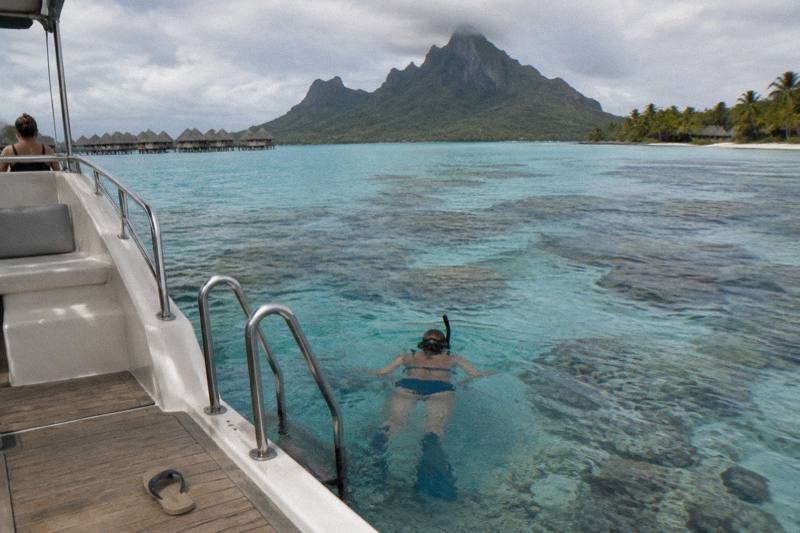
Can Non-Swimmers Join A Bora Bora Snorkeling Trip?
A plain answer for weak swimmers: which Bora Bora lagoon tours provide flotation, shallow stops and guide support, which formats to treat with care, and how to prepare.
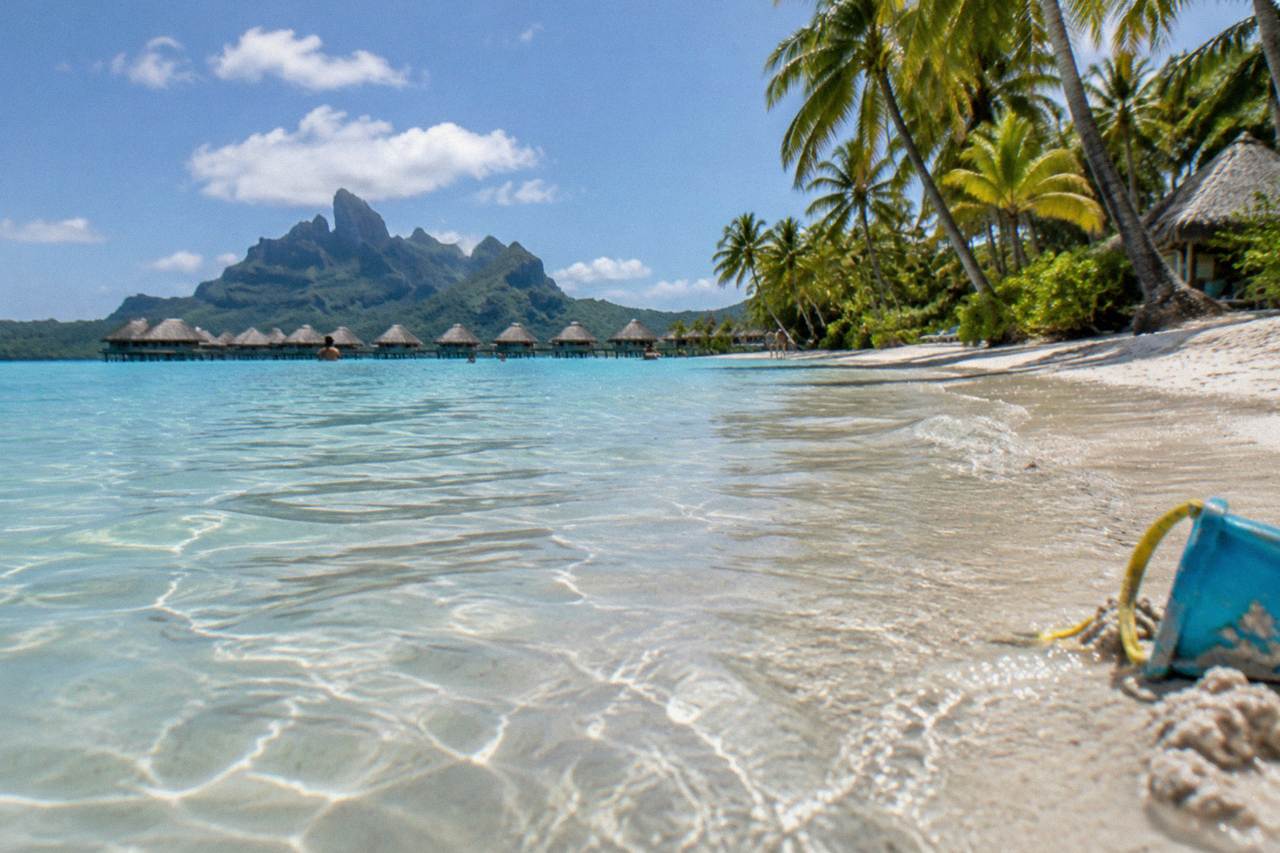
Yes, in most cases. Bora Bora's lagoon tours are built around shallow, sheltered water, and operators such as H2O Bora Bora and O-Sea Bora Bora state in their own FAQ pages that they welcome non-swimmers, supply life jackets or flotation, and adapt to all swimming levels with guided supervision. The listing, not the reef, decides: check the inclusions and the tour's own wording before booking.
The question comes up more often than you might expect, and the answer is genuinely reassuring. A Bora Bora snorkeling trip is not an open-water swim. It is a series of short stops in a lagoon that operators and guides describe as shallow and calm for much of the year, with the boat never far away and a guide in the water beside the group. The coral gardens, ray sandbars and shark stops that define these tours were chosen precisely because ordinary holidaymakers, not trained swimmers, can float over them.
That said, "non-swimmer" covers a wide range, from a confident floater who never learned strokes to someone genuinely anxious in water deeper than chest height. This article walks through what the listings actually provide, which formats fit best, which deserve more care, and how to prepare so the day feels like a highlight rather than an endurance test. We compared the listings in the lineup, and the differences between them matter far more for a non-swimmer than for a strong swimmer, who could happily take almost any of them.
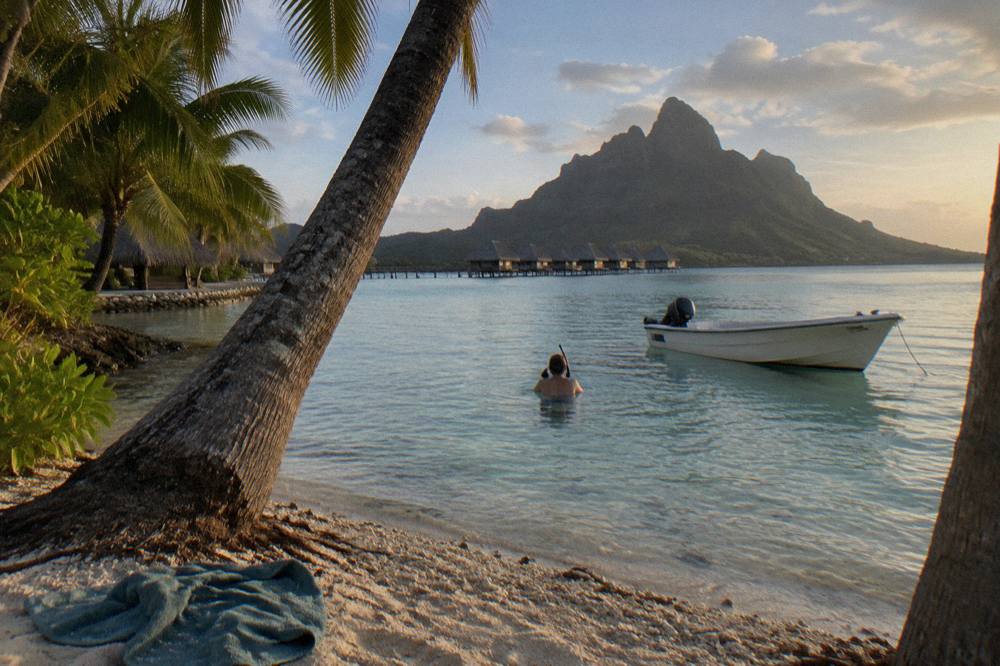
A useful starting comparison: the small-group half day run by Lagoon Service, the shared morning or afternoon snorkel from H2O Bora Bora, and the full-day lagoon group tour with lunch all list pickup, free cancellation and snorkel gear. Between them they cover the three formats a non-swimmer should be choosing among, and each is discussed in detail below.
How Do Bora Bora Tours Support Weak Swimmers?
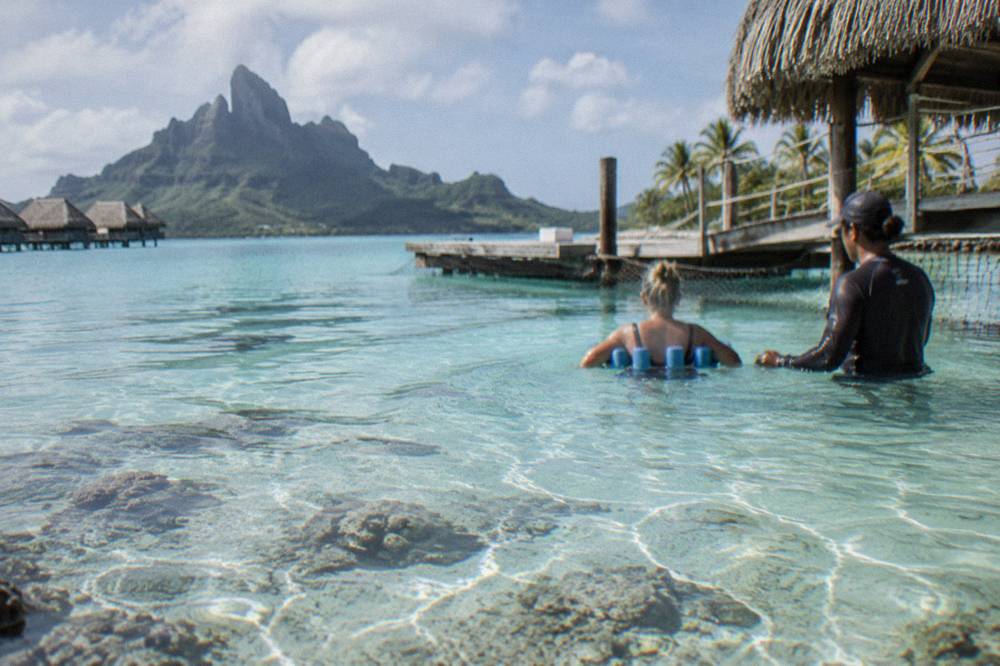
Flotation first. Operators in the lineup supply snorkel gear as a stated inclusion, and several operators' own FAQ pages say explicitly that life jackets and flotation devices are provided and non-swimmers are welcome, with tours adapted to all swimming levels under a guide's supervision. Stops are in shallow lagoon water, the boat stays close, and guides brief guests before entering the water.
The clearest statements on this come from the operators themselves. H2O Bora Bora's FAQ page states that life jackets and flotation devices are available and that non-swimmers are explicitly welcome, with tours adapted to every swimming level. The H2O Bora Bora FAQ says it in plain terms, and O-Sea Bora Bora publishes the same position on its own questions page, describing guided supervision for guests of all abilities. That is two independent operators making the same commitment in writing, which is worth more than any generic reassurance a booking page could offer.
Beyond flotation, the structure of the day works in a non-swimmer's favor. A lagoon tour is not one long swim. It is a boat ride broken into three or four stops, each usually lasting a while in water shallow enough to stand or hold the boat's line, with a ladder back up when you have had enough. Guides brief guests on the site before anyone gets in, stay in the water with the group, and, on the shark and ray stops, handle the close interactions while guests watch from a comfortable distance. The practical advice repeated across safety guidance is to shuffle your feet in sandy shallows around rays, let guides manage any close encounter, and never grab or chase an animal.
What a weak swimmer should not do is treat the listing's silence as refusal. Where a lineup line says "not stated" for an inclusion, that means the listing does not mention it, not that it is unavailable. The eco shark safari listing, for example, does not state snorkel gear, and the Tohora afternoon snorkel does not state free cancellation. In both cases the answer is a message to the operator before booking, asking two simple questions: is flotation provided, and can a non-swimmer sit out any stop. Operators who welcome non-swimmers tend to answer that message quickly and warmly.
| Support the listings and operator pages describe | What it means for a non-swimmer |
|---|---|
| Life jackets and flotation devices provided | Float without swimming; operator FAQ pages state non-swimmers are welcome |
| Snorkel gear listed as an inclusion on most tours | No need to bring or rent a mask and snorkel |
| Guides in the water with the group | Someone is beside you at every stop, not watching from the boat |
| Shallow, sheltered lagoon stops | Standing depth or holding depth at many sites; the boat stays close |
| Pickup listed on nearly every tour | No energy spent reaching the departure point |
| Free cancellation listed on most tours | Room to change plans if nerves or weather argue against it |
If the reassurance you need is about the animals rather than the water, the guide to swimming with sharks and rays in Bora Bora covers the species, the rules and the guide briefings in detail.
Which Bora Bora Lagoon Tours Suit Non-Swimmers Best?
Small-group and shared half days are the natural fit. The Half-Day Small-Group Cruise with Snorkelling from Lagoon Service runs 4 hours from $134 per person, and the shared H2O Bora Bora half day runs 3 hours 30 minutes from $130 per person, both listing pickup, free cancellation and snorkel gear. Short duration, small water time and a guide close by matter more than any other factor.
The small-group format deserves its reputation here. On a small-group cruise the guide can keep an eye on everyone individually, the boat is rarely crowded at the ladder, and a nervous guest who wants to end a stop early is a quiet word rather than a logistical problem. The Half-Day Small-Group Cruise with Snorkelling, run by Lagoon Service, carries a 5.0 rating from 203 reviews, lists pickup, free cancellation and snorkel gear, and keeps the whole commitment to four hours including transfers. For a first-time floater, that ceiling on the day's length is itself a comfort: you are never more than a couple of hours from the dock.
The shared half day from H2O Bora Bora makes an equally strong case from a different angle. It is the operator whose FAQ page states plainly that non-swimmers are welcome and flotation is provided, so the reassurance comes from the horse's mouth rather than from inference. At 3 hours 30 minutes and from $130 per person, with pickup, free cancellation and gear listed, it is effectively the same proposition in a shared format: a morning or afternoon, three or so stops, and a guide in the water throughout. Its 5.0 rating from 774 reviews reflects a large pool of guests, many of them first-time snorkelers on honeymoon or family trips.
Is a shared half day right for your group?
Free cancellation is listed, so you can lock a date now and adjust plans if needed.
The full-day lagoon group tour with lunch extends the same formula across six hours, from $173 per person, with a motu lunch breaking up the water time. It carries 5.0 from 1,715 reviews, the most reviewed listing in the lineup, and it lists pickup, free cancellation, meal and snorkel gear. For a non-swimmer it is a bigger commitment, but a well-paced one: the longer day usually means more total boat time, a relaxed lunch ashore on a motu, and no pressure to swim at any stop you would rather watch from the deck. Some guests find the lunch break resets their nerve for the afternoon stops.
Cheaper shared options exist and suit a non-swimmer fine when flotation is confirmed. The Rohivai half-day lagoon safari runs 4 hours from $112 per person with pickup and free cancellation listed, and the eco shark and ray cruise from Moana Adventure Tours runs 2 hours 30 minutes from $107 per person, the shortest water commitment on the half-day lineup. A shorter tour is not automatically easier, since a compact schedule can mean less time to settle at each stop, but for a guest who wants to test the experience with a clear exit ramp, brevity has real value.
| Listing | Format and duration | Price | Rating and reviews | Stated inclusions |
|---|---|---|---|---|
| Half-Day Small-Group Cruise with Snorkelling (Lagoon Service) | Small group, 4 hours | From $134 per person | 5.0 from 203 reviews | Pickup, free cancellation, snorkel gear |
| Half Day Snorkeling Shared Boat Tour (H2O Bora Bora) | Shared, 3 hours 30 minutes | From $130 per person | 5.0 from 774 reviews | Pickup, free cancellation, snorkel gear |
| Full Day Lagoon Group Tour with Lunch (Lagoon Service) | Small group, 6 hours | From $173 per person | 5.0 from 1715 reviews | Pickup, free cancellation, meal, snorkel gear |
| Rohivai Half-Day Lagoon Safari | Shared, 4 hours | From $112 per person | 4.9 from 259 reviews | Pickup, free cancellation |
| Eco Shark and Ray Cruise (Moana Adventure Tours) | Small group, 2 hours 30 minutes | From $107 per person | 4.8 from 604 reviews | Pickup, free cancellation |
One pattern worth noticing in that table: every one of these listings states free cancellation. That is not a coincidence of the lagoon category, it is the norm in this lineup, and for a non-swimmer it converts the booking from a commitment into an option. You can reserve the date that suits your trip, then message the operator about flotation, and still withdraw without penalty if the answer leaves you unsure. The comparison of private and group lagoon tours works through the same trade-off from a budget angle.
Which Tour Formats Should Non-Swimmers Approach With Care?
Not the animals, and not the depth: the formats to weigh carefully are the long combos and anything sold on speed. The 8-hour lagoon and 4WD combination, the jet ski combos at 6 hours or more, and the full-day seven-hour listings all stretch a nervous guest's stamina, while a short shared half day keeps every exit close. The lagoon itself stays shallow and calm either way.
Start with duration, because it compounds. Six to eight hours is a long day for anyone, and for a guest managing anxiety as well as buoyancy it can turn a good morning into a long afternoon. The 8-hour lagoon and 4WD combination from Vavau 4x4 Adventures, from $158 per person, is a superb listing for a confident traveler, but half of it is a truck circuit of the island, and a non-swimmer should be honest about whether a full-day double-format serves them or just fills the schedule. The same logic applies to the jet ski combos, such as the 6 hours 30 minutes jet ski and eco shark cruise from $303 per person: riding a jet ski is its own skill and its own set of nerves, and stacking it on top of a first snorkel is a lot of new things in one day.
Private boats are the interesting exception, and they cut both ways. A private trip, such as the H2O Bora Bora private boat from $650 per group for 3 hours 30 minutes, gives you the crew's undivided attention, total control over how long each stop lasts, and the freedom to skip a site entirely if it looks beyond your comfort. That is arguably the most supportive format in the lineup for a genuinely anxious non-swimmer. The trade is price: from $650 per group is a different budget conversation than from $112 per person, though split across a family or a group of friends it narrows considerably.
The listings to read most carefully are those whose selling point is adventure. The luxury catamaran sailing and snorkeling trip with its floating bar, from $309 per person for 4 hours, is a beautiful product, and the sailing and the bar are the draw; the snorkel stop is one component rather than the spine of the day, which suits a guest who wants the water to be optional scenery. The eco shark safari at 2 hours 30 minutes is honest about its focus, sharks and rays at natural congregation sites, and its brevity helps, but a guest uneasy about swimming over sharks, however briefly, should choose a coral-garden-focused listing instead and read the manta rays guide before deciding whether ray sites belong on their itinerary at all.
No format in the lineup is forbidden to a non-swimmer, and that is worth saying plainly. The distinction is between formats that support you and formats that test you. Anything with a guide in the water, flotation on request, and stops measured in minutes rather than hours is support. Anything that asks you to hold a schedule, master a machine, or stay in the water while the group moves on, is a test, and tests can wait for the second trip.
What Should You Ask Before Booking As A Non-Swimmer?
Three questions to the operator settle it: is flotation provided and is it worn or held, can a guest stay on the boat at any stop without pressure, and how deep is the water at each site relative to standing height. Ask in writing through the listing's message thread, book only when the answer is specific, and prefer listings that state free cancellation while you wait for the reply.
The first question sounds obvious, but the detail matters. A flotation belt you wear for the whole stop is a different proposition from a life jacket you can grab if needed, and a noodle you hold is different again. Operators who welcome non-swimmers, as H2O Bora Bora and O-Sea Bora Bora state they do, will answer this without hesitation, often with more detail than you asked for. An operator who answers vaguely is telling you something too, and there are enough alternatives in this lineup, 13 half-day listings alone, that a vague answer is a reason to move on rather than a reason to hope. More of these guides are collected on Bora Bora Snorkeling Tours.
The second question, about sitting out a stop, tests the culture of the boat. The honest answer from any well-run lagoon tour is that staying aboard is always fine, because half of any group at the shark stop is watching from the rail anyway, cameras out. The listing that frames every stop as unmissable is marketing, not policy. Ask anyway, because the reply tells you whether the guide's style matches what you need.
The third question, about depth, needs careful handling on your side as well as theirs. Visibility and exact site depth figures are not something this site quotes, because they vary and no official measurement is on file; operators and guides describe the classic stops as shallow and beginner-friendly, and 2026 guides describe Matira's shore snorkeling as one to three meters over sand. What you want from the operator is not a number but a description: can guests stand, can guests hold a line off the boat, is there a current today. Descriptions age better than figures and so do the answers.
A short pre-booking checklist, built from the lineup lines rather than from promises:
| Before you book | Why it matters for a non-swimmer |
|---|---|
| Flotation provided and worn or held | Converts swimming into floating; ask which style the operator uses |
| Guide in the water with the group | Supervision stated by operators that welcome non-swimmers |
| Stop length measured in minutes | Short floats at shallow sites, ladder back up whenever you choose |
| Free cancellation stated in the booking details | Book the date, ask the questions, withdraw if the answers disappoint |
| Pickup listed | Conserves energy and removes transfer stress |
| Half-day or small-group label in the booking details | Both formats give the guide capacity to stay close |
The shared half day from H2O Bora Bora is the listing most worth messaging first, because its operator's FAQ already commits to the answers you are asking for. It runs 3 hours 30 minutes from $130 per person with pickup, free cancellation and snorkel gear listed, and it holds a 5.0 rating from 774 reviews. You can also check availability alongside the shared half day tour page while you wait for a reply.
How Should A Non-Swimmer Prepare For The First Snorkel Stop?
Practice breathing through a mask in standing-depth water, accept the flotation before you need it, and treat the first stop as a look rather than a swim. Guests report that the mask, not the water, is the usual obstacle: the feeling of breathing through the mouth while the face is submerged is strange for about two minutes, then routine. A pool session or a bathtub the week before removes nearly all of that strangeness.
Preparation for a non-swimmer is mostly about the face, secondly about the feet. The mask-and-snorkel combination is the single most common reason a first-timer panics, and it is entirely trainable on dry land or in a pool. Put the gear on in the shallows of a pool, or stand in the sea at Matira Beach, the island's public beach with free access and shallow water, and simply breathe. Nothing else. Once breathing through the snorkel feels dull, which it does quickly, the hardest part of the day is behind you. The Matira Beach snorkeling guide covers practicing from shore before committing to a boat.
The feet matter at the ray stops. The repeated advice across safety guidance is to shuffle through sandy shallows rather than step, because stingrays rest buried in sand and use their barbed tail defensively if stepped on or grabbed. Guides manage close interactions themselves and brief guests before entering; your job is the shuffle, the hands-off rule, and staying where the guide points. Around blacktip reef sharks, typically half a meter to one and a half meter, the etiquette is simpler still: float, watch, and let the animals pass beneath, which they commonly do at the sites operators visit.
Clothing and skin preparation help more than they get credit for. A rash guard adds warmth and confidence, removes the need to reapply sunscreen on the boat, and sidesteps the sunscreen question that travelers ask about; there is no blanket chemical-sunscreen ban in French Polynesia, but mineral formulas with non-nano zinc oxide or titanium dioxide are strongly recommended by guides to protect the reef. The what to bring snorkeling list itemizes the rest. A sea-temperature series puts the lagoon between 26 and 29 degrees C year round, so a rash guard is usually enough thermal protection even for a guest who floats motionless for a while.
On the day itself, sequence matters. Take the flotation before you leave the boat, not after you tire. Enter via the ladder or the stern step rather than a leap. Hold the boat's line for the first minute and look down; most first-time non-swimmers discover the reef is absorbing enough to make forgetting the water easy. And when you have had enough, say so. Guides in this lineup host nervous guests every week, and a guest who communicates is a guide's favorite guest, not their problem.
Do Children And Nervous Adults Face The Same Rules?
Effectively yes, with supervision attached. Guides and safety sources report children are welcome on most lagoon tours with adult supervision required, many operators supply child-sized gear and life jackets, and the same deeper or manta-focused stops that call for confident swimmers apply to both ages. Some listings carry age, weight or medical restrictions, so the listing's fine print is the deciding document for a child.
The parallel is closer than most parents expect. A nervous adult and a seven-year-old need the same things from a lagoon tour: a life jacket that fits, water they can stand in, a guide within arm's reach, and stops short enough that enthusiasm outlasts the novelty. Operators who state they welcome non-swimmers tend to be the same operators who supply child-sized gear, because both promises come from the same small-group, high-supervision culture. The family-focused detail is in the Bora Bora snorkeling with kids article, which works through age limits and family formats separately.
Where the two diverge is restrictions. Adults rarely meet an age or weight limit, but children sometimes do, and medical conditions such as back problems or pregnancy appear in the fine print of several adventure-format listings. The rule this site applies to every article applies doubly here: read the listing's own restrictions section rather than assuming, because restrictions vary between listings run by the same operator with different durations and inclusions. The lineup's same-operator variants are genuinely different products, priced and structured differently, and a child-friendly half day does not guarantee the same operator's full-day combo follows the same rules.
For a family booking, the small-group half day remains the strongest default. The Half-Day Small-Group Cruise with Snorkelling gives a family the guide-to-guest ratio that keeps two nervous swimmers and one confident one all inside their comfort zone, in four hours from $134 per person, with pickup, free cancellation and snorkel gear listed. Families ready for a longer day graduate naturally to the full-day lagoon tour with lunch, at 5.0 from 1,715 reviews the most reviewed listing in the lineup, where the motu lunch gives children a beach hour between water sessions and gives parents a break that is part of the itinerary rather than a negotiation.
The last word on nerves, for adults and children alike: the ocean does not know your age. A guest who tells the guide at the first stop that they are not a confident swimmer has just made the guide's job straightforward and their own day safe. The operators who publish their welcome are counting on that conversation happening, and every piece of guidance from the safety sources points the same way.
The full-day lagoon group tour with lunch, the lineup's most reviewed listing, shows the same pattern at larger scale for mixed groups where only one member is unsure in the water.
Between formats, budgets and confidence levels, the trio below is where most non-swimmers land: the traditional outrigger canoe snorkel as a gentle short first outing, the shared half day for the operator's stated welcome, and the full day with lunch once the float feels like home.
Common Questions About Non-Swimmers Snorkeling In Bora Bora
Can non-swimmers snorkel in Bora Bora?
Yes. Operators including H2O Bora Bora and O-Sea Bora Bora state on their own FAQ pages that life jackets and flotation are provided and non-swimmers are welcome, with tours adapted to all swimming levels under guide supervision. Stops are short, the water is shallow and sheltered, and the boat stays close throughout.
Do Bora Bora Snorkel Tours Allow Guests Who Cannot Swim?
Most can. The listings that fit best are shared or small-group half days such as the Lagoon Service 4-hour cruise from $134 per person or the H2O Bora Bora shared half day from $130 per person, both listing pickup, free cancellation and snorkel gear. Confirm flotation with the operator before booking.
Do Bora Bora tours provide life jackets and flotation?
Several operators state that they do, explicitly welcoming non-swimmers with flotation and guided supervision. Where a listing does not mention flotation, that means it is not stated, not that it is unavailable: message the operator through the listing before booking.
Which tours should a non-swimmer avoid in Bora Bora?
Nothing is forbidden, but long combination days deserve caution. The 8-hour lagoon and 4WD combo and the jet ski combos of 6 hours or more stack new skills and long schedules onto a first snorkel. A short shared half day, or a private boat where the crew controls pacing, supports a nervous guest far better.
Can you stand in the water at the snorkel stops?
Operators and guides describe the classic lagoon stops as shallow and beginner-friendly, and 2026 guides describe Matira's shore snorkeling as roughly one to three meters over sand. Conditions vary by site and tide, so ask the operator to describe each stop rather than quote a depth, and use flotation at any stop where standing is uncertain.
Is it safe for a non-swimmer to be in the water with sharks and rays?
Blacktip reef sharks, typically half a meter to one and a half meter, are the common species on lagoon tours, and stingrays act defensively only if stepped on or grabbed. Guides brief guests, manage close interactions, and advise shuffling feet in sandy shallows. French Polynesia has protected all shark and ray species since 2006, and operators follow rules that prohibit altering the animals' behavior.