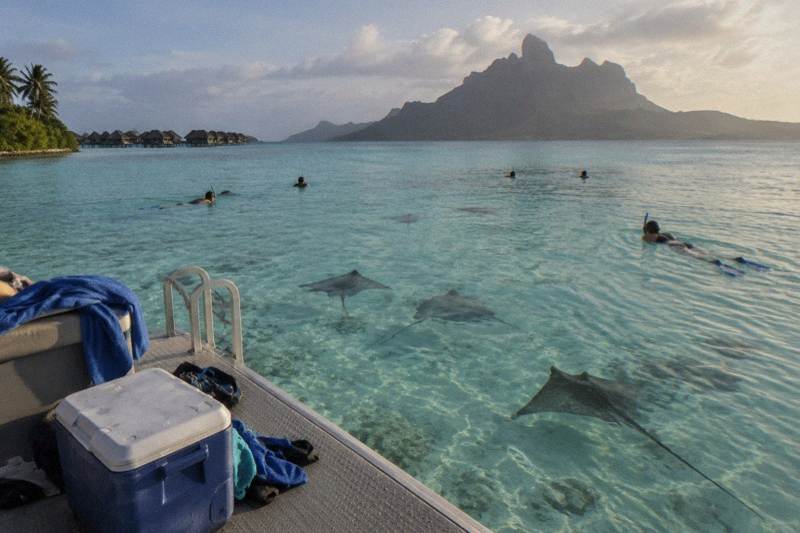
Bora Bora Lagoonarium: Is It Worth The Stop?
The Lagoonarium sits on its own motu in the Bora Bora lagoon and sells a guided, enclosed version of the snorkeling that the wider lagoon offers in the wild. Here is what it costs, what it includes, and how it stacks up against the boat tours that circle the island.
Short answer
The Bora Bora Lagoonarium is a natural lagoon enclosure on a private motu offering guided snorkeling with sharks, rays and turtles, from about 7,700 CFP (roughly $72) for a half day. It suits cautious swimmers and families; confident snorkelers usually get more from a full lagoon tour from $105 per person.
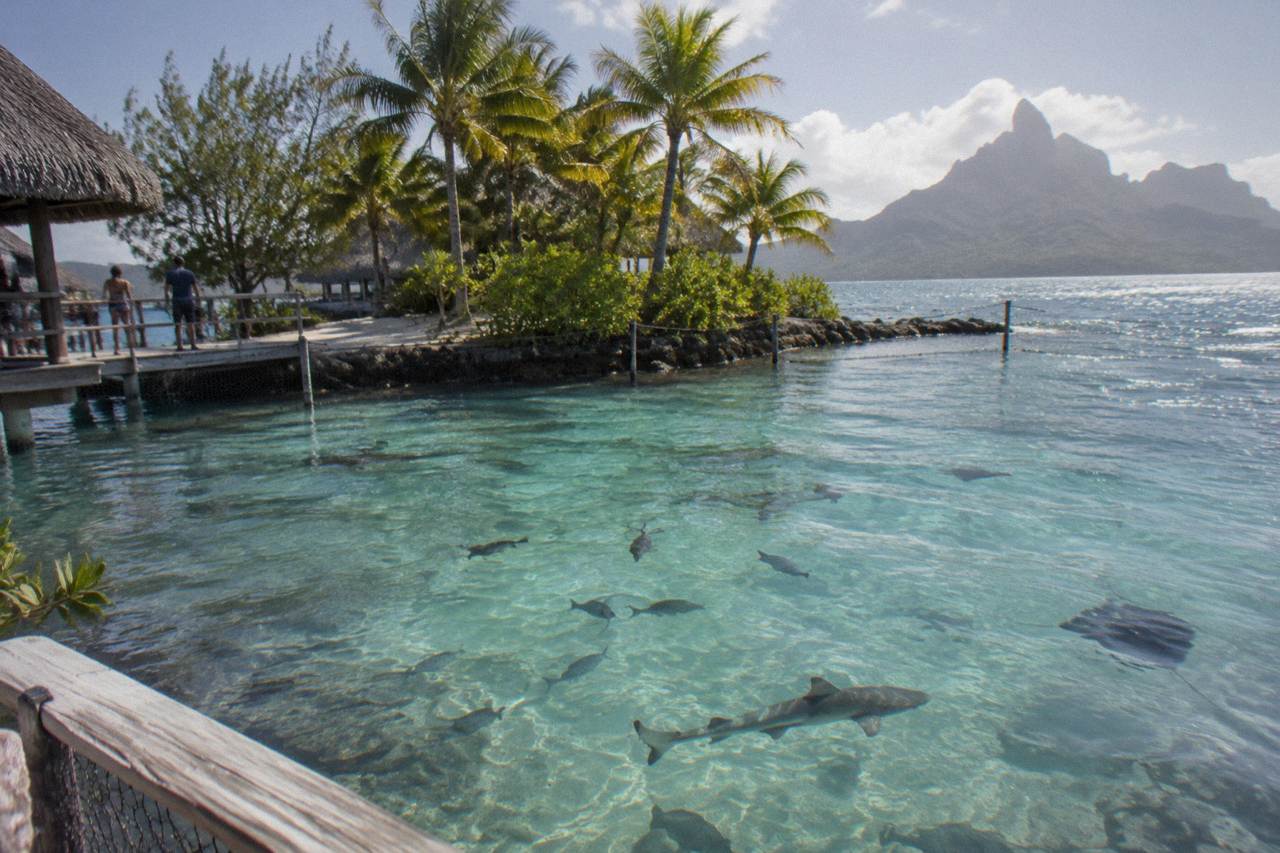
The Bora Bora Lagoonarium is one of those names that sounds like a theme park and turns out to be something stranger: a natural lagoon pool on a private motu, on the eastern side of the island, where guests snorkel in an enclosed section of the real lagoon under a guide's supervision. It is not an aquarium with glass walls. It is a fenced-off piece of the lagoon itself, stocked and managed so that the animals people cross the world to see, blacktip reef sharks, stingrays, eagle rays and sea turtles, are commonly present rather than hoped for.
That difference matters when you are planning a trip, because the Lagoonarium competes for the same half day as the shared and small-group lagoon snorkel tours that circle Bora Bora's reef. The Reef Discovery half day, the full-day lagoon tour with lunch and the eco shark and ray cruise all visit open water sites where nothing is enclosed. This guide lays out what the Lagoonarium is, what it costs, what you actually get for the money, and who it genuinely suits, so you can decide whether it belongs in your itinerary or whether a boat tour serves you better. Once you have picked your lagoon activity, the full Bora Bora budget breakdown shows how that choice ripples through the rest of what you will spend on the island.
What Is The Bora Bora Lagoonarium?
The Lagoonarium is a guided marine attraction on a private motu in Bora Bora's lagoon, where guests snorkel in an enclosed natural lagoon pool alongside blacktip reef sharks, several ray species, sea turtles and reef fish, with staff in the water supervising every session. It runs Sunday to Friday, from 8 a.m. to 3 p.m., and closes Saturdays.
The concept is Polynesian rather than corporate. The motu's lagoon pool is divided so that different animals live in different sections, and visits are structured around guided snorkeling sessions rather than free wandering. A guide leads each group into the water, points out the animals, and manages the pacing, which is why the attraction markets itself to families and to visitors who want marine life without the variables of an open-ocean snorkel stop.
It sits a short boat ride from the main island, reachable on organized transfer, which means it functions almost like a shore excursion: you arrive, you swim in the enclosure, you watch from the edges if you prefer not to get in, and you leave on the return boat. Guides and recent visitor coverage describe the water as shallow and calm, with the enclosure sheltered from the lagoon's windier stretches.
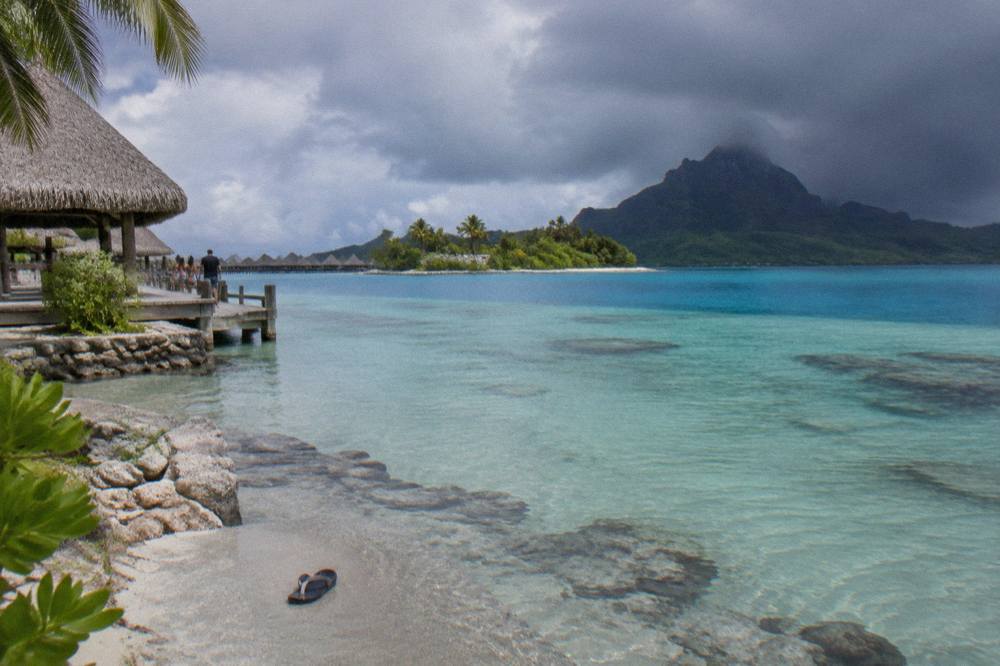
The comparison that comes up again and again in planning forums is with the Lagoon Service full-day lagoon tour with lunch, which at 5.0 from 1,715 reviews is the most reviewed product on this site's lineup. That tour covers the open lagoon: coral gardens, ray and shark stops, a motu lunch, from $173 per person. The Lagoonarium covers one motu, deeply. If your priority is ticking off the classic lagoon itinerary, a circle-island boat tour is the stronger buy, a point developed later in this guide.
One context note worth knowing: the southern reef off Matira is now closed to boats and nautical activity under the Popora rahui, a 574-hectare full-protection zone created by decree in December 2025, the first of its kind in French Polynesia. Tours do not enter it. The Lagoonarium sits well away from that zone and continues operating normally, but the rahui is part of a wider shift toward managed marine tourism in the lagoon, and it explains some of the changing route maps you may see on operator pages.
How Much Does It Cost To Go To The Bora Bora Lagoonarium?
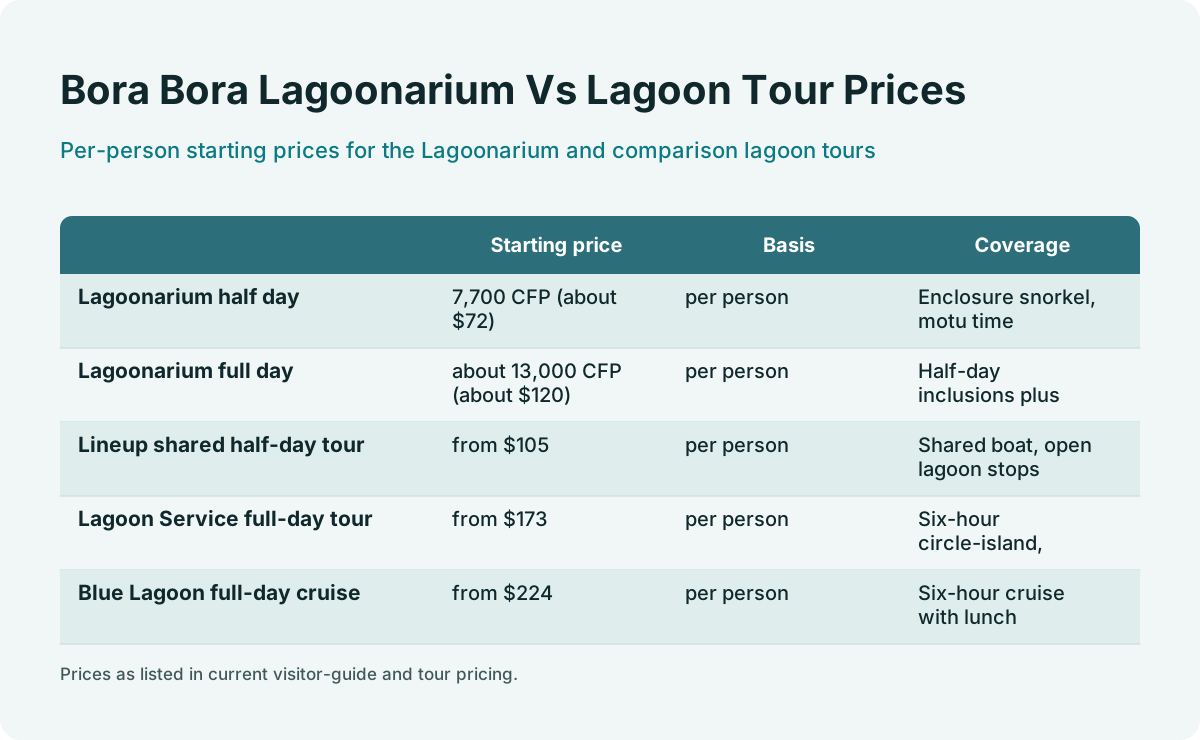
A half-day Lagoonarium visit starts from 7,700 CFP, roughly $72 per person, with full-day options from around 13,000 CFP, roughly $120, according to current visitor-guide pricing. For comparison, lineup lagoon tours run from $105 per person for the cheapest shared half day up to from $224 per person for a premium full-day cruise.
Those Lagoonarium figures come from recent travel coverage rather than a booking listing, so treat them as planning numbers and confirm the current rate when you contact the attraction. The half day typically includes the guided snorkeling sessions and time on the motu; the full day adds lunch and a longer rotation through the pools. Neither figure includes your transfer from Vaitape or a resort dock, which is usually arranged separately or bundled depending on how you book.
| Option | Starting price | Basis | What it covers |
|---|---|---|---|
| Lagoonarium half day | 7,700 CFP (about $72) | per person | Guided snorkeling sessions in the enclosure, motu time |
| Lagoonarium full day | about 13,000 CFP (about $120) | per person | All half-day inclusions plus lunch and longer access |
| Cheapest half-day tour | from $105 | per person | Shared boat, guide, snorkel stops across the open lagoon |
| Most reviewed full-day tour | from $173 | per person | Six-hour circle-island tour with lunch, gear and pickup |
| Premium full-day cruise | from $224 | per person | Six-hour Blue Lagoon cruise with lunch |
The pattern in that table is the honest headline: the Lagoonarium is not dramatically cheaper than a boat tour, and on a per-hour basis it can work out more expensive. What you are paying for is reliability and supervision rather than coverage. The enclosure makes the animals a common sight rather than a probable one, and the guided format means weak swimmers are never left to cope alone.
For readers weighing budget across a whole trip, the deeper numbers live in the Bora Bora snorkeling cost guide, which breaks down tour tiers, add-ons and what a week of snorkeling realistically totals. Money spent here competes directly with money spent on a full-day tour, and most visitors only have room for one big lagoon day.
If you are leaning toward the boat rather than the enclosure, these are the three listings this site would put in front of you first, all with pickup and free cancellation listed:
What Do You Actually See At The Lagoonarium In Bora Bora?
The Lagoonarium's pools hold blacktip reef sharks, lemon sharks in a deeper section, pink whip stingrays, southern stingrays, eagle rays, sea turtles and dense schools of reef fish, all visible under guided supervision, and sightings inside the enclosure are described as routine rather than seasonal luck. The listing and guide coverage frame the animals as resident, not guaranteed.
Blacktip reef sharks, typically half a meter to a meter and a half long, are the species lagoon visitors encounter most across Bora Bora generally, and operators report they are the enclosure's staple. Rays cluster in the sandy shallows where guests stand in chest-deep water. Turtles are the quieter draw, resting near the pool edges. Guides brief every group before entering, and the same rules apply here as anywhere in French Polynesia: the country's shark and ray sanctuary, in force since 2006, protects all species in its waters, and the Environmental Code prohibits attracting sharks or altering their behavior.
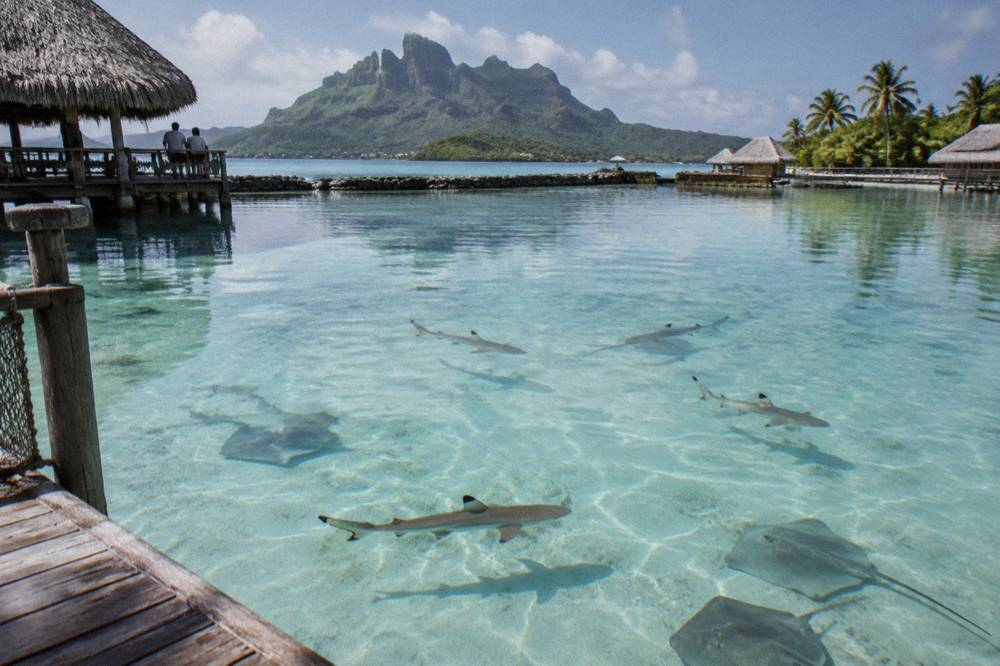
It is worth saying plainly what the enclosure changes. On an open-lagoon tour, the boat anchors at a coral garden or ray site and the animals are wild, present because the site suits them. At the Lagoonarium, the fences do the work. Neither version promises a sighting, and honest copy on both should not, but the enclosure concentrates the odds in a way a wild stop cannot. Some travelers find that trade rewarding; others find it takes the wildness out of the encounter, and both reactions are legitimate.
Swimming with the sharks and rays outside an enclosure carries its own considerations, and the swim with sharks and rays guide covers the species, the guide briefings and the sanctuary rules in full. Broadly: stingrays use their barbed tail defensively, so guides tell guests to shuffle in sandy shallows and to let staff handle close interactions, and blacktips are described by operators as uninterested in swimmers when left alone.
For a family split between nervous and confident swimmers, the Lagoonarium's structure is its real product. Sessions run on the attraction's schedule, staff control the pace, and nobody has to manage open water or a boat ladder in swell. The snorkeling with kids guide makes the same point about guided formats generally: supervision, not scenery, is what makes a first marine encounter work.
Can You Visit The Bora Bora Lagoonarium From Vaitape Or A Cruise Ship?
Yes. The Lagoonarium is reached by boat transfer from the Bora Bora main island, and cruise passengers can walk from the Vaitape tender quay, about 50 meters on foot from the tender wharf, to a departure point; a typical tender ride from the anchorage to Vaitape takes 15 to 20 minutes. Cruise calls commonly allow 9 to 12 hours ashore, enough for a half-day visit.
The logistics are the same ones every shore excursion in Bora Bora works with. Ships anchor in the lagoon, often toward the Pofai Bay area, and tender all passengers to the single public quay at Vaitape. From there, tours and attractions either pick up at the quay or at resort docks around the lagoon, and most listings name hotel and Vaitape pickup explicitly. The Lagoonarium's transfer follows the same pattern, arranged at booking.
| Starting point | Distance or time to consider | Notes |
|---|---|---|
| Cruise tender anchorage to Vaitape quay | 15 to 20 minutes typical | Single public tender pier for all lines |
| Vaitape quay to departure point | About 50 m on foot from the wharf | The tender wharf sits essentially in Vaitape |
| Vaitape to Matira | About 7 km, 12 minutes by road | Useful if combining with the public beach |
| Resort docks around the lagoon | Pickup listed on most tours | Confirm your dock at booking |
Cruise passengers should watch the clock the way every independent excursion here requires: ships depart when they depart, and the all-aboard rule is the only guarantee. A morning Lagoonarium session ending by early afternoon fits comfortably inside a typical call window. The deeper comparison between ship-organized and independent options, including the consistent finding that independent tours price below ship equivalents, is laid out in the cruise shore excursions guide.
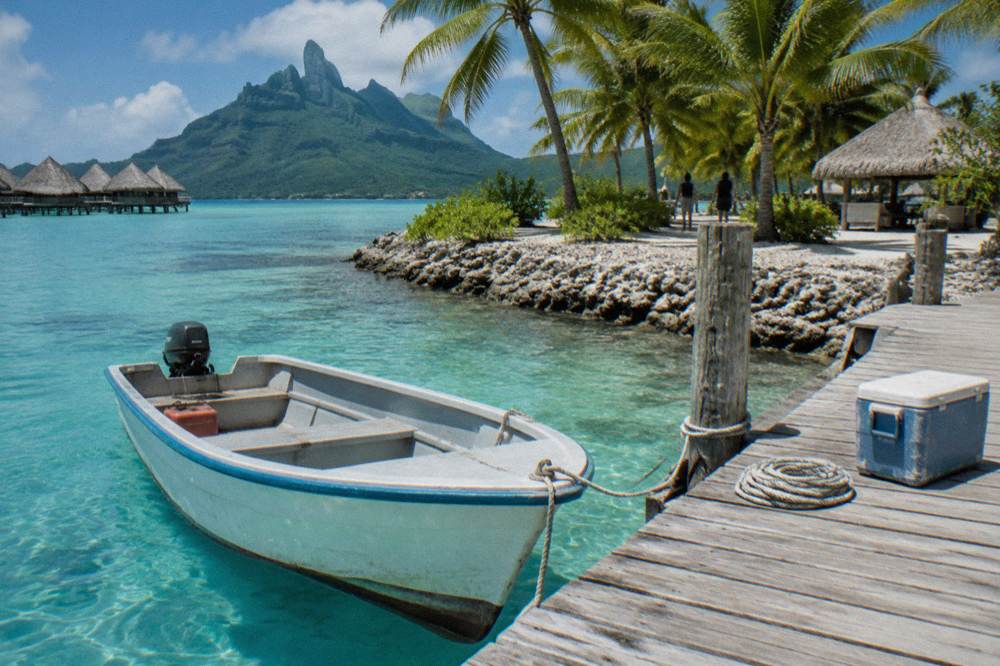
If your call is short and you want the open lagoon rather than the enclosure, the compact options in the lineup are the Vavau three-hour lagoon snorkel, from $118 per person, and Moana Adventure Tours' two-and-a-half-hour eco shark safari, from $107 per person. The Lagoon Service bilingual lagoon tour and snorkel, four hours from $132 per person, is another mid-length fit:
Its 4.8 from 102 reviews reflects a well-established operator running a bilingual format, which matters on a port day when you want instructions you fully understand. Between the enclosure and a boat like this, the decision is really about depth of water confidence versus breadth of lagoon coverage.
Lagoonarium Or A Circle-Island Lagoon Tour: Which Suits You Better?
Choose the Lagoonarium if you want supervised, shallow, close-up animal time in a compact half day, especially with anxious swimmers or young children. Choose a circle-island lagoon tour if you want the full Bora Bora itinerary, coral gardens, ray stops, shark stops and a motu lunch, and you are comfortable in open water; the tours deliver far more lagoon per dollar.
This is the decision most readers arrive at, and it is genuinely a personality question rather than a quality ranking. The two products barely overlap. One keeps you on a single motu with resident animals; the other moves you through the lagoon's greatest hits with a guide who reads conditions on the day.
| Factor | Lagoonarium | Circle-island lagoon tour |
|---|---|---|
| Time commitment | Half day, fixed sessions | 6 to 7 hours for full-day listings |
| Water depth | Shallow, enclosed pools | Open lagoon stops, variable |
| Animals | Resident sharks, rays, turtles | Wild sites; commonly reported, never promised |
| Coverage | One motu | Coral gardens, ray and shark stops, motu lunch |
| Lunch | Full-day option only | Included on most full-day listings |
| Starting price | About $72 half day, $120 full day | From $144 per person in the lineup |
On the tour side, the strongest full-day value in the lineup is the Lagoon Service full-day lagoon group tour with lunch, from $173 per person, 5.0 from 1,715 reviews, small group, six hours, with pickup, gear and a meal all listed. This site's featured pick for this topic, it is the benchmark the Lagoonarium has to beat, and for most confident swimmers it does not come close on coverage. Check availability on the operator's live listing if that format fits.
The Rohivai-run full-day lagoon safari with lunch on a motu is the natural alternative, from $170 per person, 4.9 from 825 reviews, six hours with pickup and a Polynesian-style picnic lunch:
And for readers who only have a morning, the Reef Discovery half-day group signature tour, 5.0 from 1,051 reviews, three and a half hours from $134 per person, compresses the circle-lagoon idea into a short window:
Between those three and the enclosure, the honest summary is that the Lagoonarium wins on supervision and certainty, and loses on scale. A reader who does both, one full-day tour plus a short Lagoonarium session on a spare morning, gets the complete picture, but on a two or three night stay most travelers should pick the boat.
When Is The Best Time To Visit The Bora Bora Lagoonarium?
The dry season, May to October, is the best window for a Lagoonarium visit and for Bora Bora snorkeling generally, with calmer lagoon conditions, lower rainfall and the clearer water operators describe in those months; the attraction runs Sunday to Friday, 8 a.m. to 3 p.m., and morning sessions are the calmer bet year-round.
Because the Lagoonarium is enclosed and sheltered, it is less weather-exposed than an open-lagoon tour, which is partly the point of it. Boats cancel or reroute when the wind picks up; a fenced pool on a sheltered motu keeps running. That makes it a reasonable rainy-season fallback, though heavy rain still dulls the water and the views of Mount Otemanu that make the setting what it is.
| Period | Rainfall at Bora Bora station | Character |
|---|---|---|
| May to October (dry season) | 61.9 to 112 mm per month | Calmer lagoon, clearer water, peak season |
| July and August | 61.9 and 63.7 mm per month | Busiest and priciest months |
| November to April (wet season) | 108.7 to 250.7 mm per month | Warmer water, rain squalls, fewer crowds |
A sea-temperature series puts the lagoon at 26.7 to 28.9 degrees Celsius across the year, so warmth is never the constraint; conditions are. Whale season runs July to November, but no lineup snorkel listing is a whale-watching product, and the Lagoonarium is no exception, so treat any whale sighting anywhere as a bonus rather than a booking reason. The month-by-month breakdown lives in the best time to snorkel guide.
What Should You Bring To The Bora Bora Lagoonarium?
Bring swimwear worn under clothes, a towel, reef-safe mineral sunscreen applied before arrival or a rash guard, water shoes for sandy and coral rough surfaces, and cash or confirmed payment for the entry and transfer; the attraction supplies the guided sessions, and mask and snorkel arrangements should be confirmed when booking rather than assumed.
The sunscreen point deserves precision because it is widely garbled. There is no blanket chemical sunscreen ban in French Polynesia as of 2026, so nobody should tell you it is a law. Guides across the islands strongly recommend mineral formulas, non-nano zinc oxide or titanium dioxide, to protect the coral, and several operators encourage rash guards as the simplest fix. The full reasoning is in the reef-safe sunscreen piece.
Beyond that, a Lagoonarium day is simpler than a boat day. You are on one motu with facilities rather than rocking on a deck, so motion-sickness worries mostly drop away. You still need sun protection for long shallow sessions where backs and shoulders cook, and the shuffle rule in sandy shallows applies to rays here exactly as it does on the tours: stingrays defend themselves if stepped on or grabbed, so shuffle and let the guides manage contact.
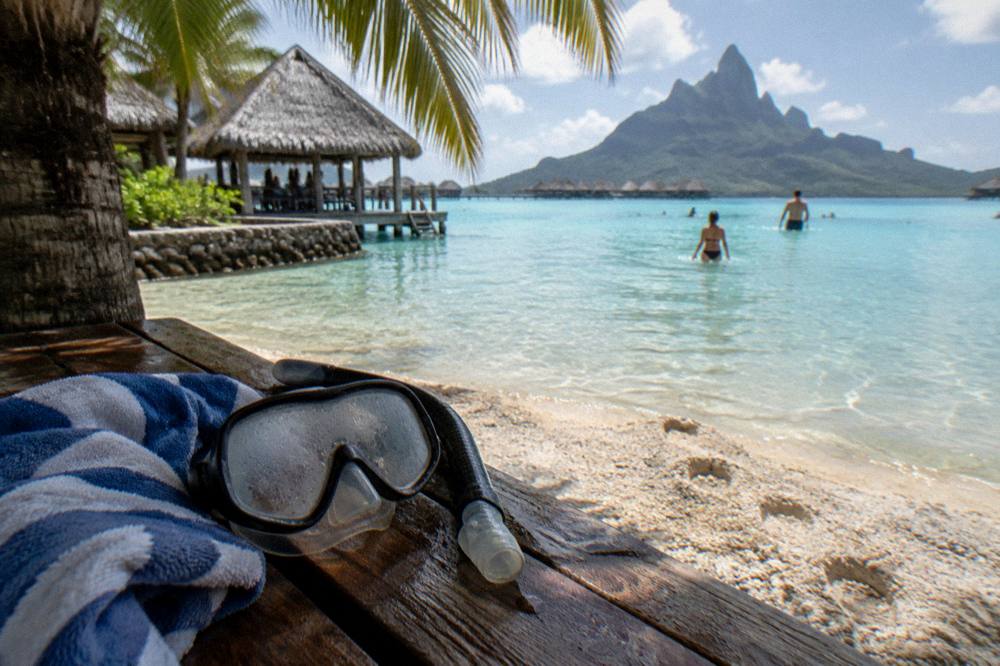
Visitors staying on the main island or arriving off a ship will find the practical packing detail, including what changes between shared and private tours, in the what to bring snorkeling guide. The short version: less than you think, protected from sun more than you expect.
Verdict: Is The Bora Bora Lagoonarium Worth The Stop?
For families, nervous swimmers and visitors with a spare half day, yes: the Lagoonarium delivers concentrated, supervised animal encounters at a fair price from about $72. For confident snorkelers with only one or two lagoon days, no: a circle-island tour such as the full-day lagoon tour with lunch at from $173 gives far more of Bora Bora for the money.
Split the verdict by traveler rather than defending one answer. A party containing a seven-year-old who has never worn a mask, a grandparent who prefers waist-deep water and one keen snorkeler will have a better collective morning at the Lagoonarium than on any shared boat, and the enclosure's structure is exactly why. Two certified-water adults on a four night honeymoon should book the boat, take the coral gardens and the ray sandbar and the motu lunch, and treat the Lagoonarium as a name they can skip without regret.
Worth noting also is what the Lagoonarium is not: it is not the lagoon. The wilder, bigger experience of Bora Bora remains the circle-island tour format, and Bora Bora Snorkeling Tours exists to help you compare those formats honestly rather than push one product. If this guide has settled you on the boat, these listings are the ones this site would shortlist first for a lagoon day.
Common Questions About The Bora Bora Lagoonarium
How much does it cost to go to the Bora Bora lagoonarium?
Half-day visits start from 7,700 CFP, roughly $72 per person, with full-day options from around 13,000 CFP, roughly $120, per current travel-guide pricing. Confirm the live rate when booking, and budget separately for the boat transfer from Vaitape or your resort dock.
Is the Bora Bora Lagoonarium suitable for non-swimmers?
Largely yes. The pools are shallow and sheltered, sessions are guided with staff in the water, and flotation is the norm at guided marine attractions. Confident swimming helps but is not the entry requirement it would be on an open-lagoon tour stop. Confirm flotation directly when booking.
Can you visit the Lagoonarium on a cruise day?
Yes. Cruise ships tender to the Vaitape quay, and the tender wharf sits about 50 meters on foot from Vaitape, where transfers and tours depart. A typical tender ride is 15 to 20 minutes and calls commonly allow 9 to 12 hours ashore, so a morning session fits comfortably. Check that your call is not a Saturday, when the attraction is closed.
Are the sharks at the Lagoonarium safe?
Blacktip reef sharks, typically half a meter to a meter and a half, are the common species, and guides brief guests before every session. No honest source calls any wild animal risk-free; the sanctuary rules that have protected all sharks and rays in French Polynesia since 2006 apply, and supervised, structured contact is the attraction's whole model.
Lagoonarium or lagoon tour: which is better for kids?
For young or first-time snorkelers, the Lagoonarium's shallow, enclosed, guided format is usually the easier introduction. For children who already swim confidently, a family-format boat tour such as the small-group full-day lagoon tour adds the motu lunch and the circle-island scenery. The snorkeling with kids guide breaks the decision down by age.
Do you need to book the Lagoonarium in advance?
Sessions run on a fixed schedule with guided groups, so capacity is genuinely limited, and cruise days concentrate demand. Booking ahead is the sensible default in the May to October dry season, and the same advice applies to the lineup lagoon tours, most of which list free cancellation if plans shift.