Is It Safe To Swim With Reef Sharks In Bora Bora?
Reef shark behavior in the Bora Bora lagoon, the rules that govern shark stops, and what actually happens when a tour boat anchors over the shallow sandbars.
Are Bora Bora's Reef Sharks Dangerous?
Yes, in the setting most visitors experience: a guided shallow-water stop with blacktip reef sharks, the species operators and guides describe as the common lagoon shark, typically 0.5 to 1.5 m long. Sightings are never promised, incidents are rare, and the legal framework is strict. The honest answer is that supervised snorkeling in the lagoon's shark areas carries very low recorded risk, while the same animals deserve caution and respect anywhere. To understand which other species swim in these waters and how protection rules shape every encounter, read our guide to Bora Bora's sharks.
Fear of sharks is the single most common hesitation before booking a lagoon tour in Bora Bora, and it is a reasonable question to ask rather than an irrational one. Any wild animal in open water deserves a serious answer, not a wave of the hand. This article walks through the species involved, their documented behavior around snorkelers, the law that governs how tours may interact with them, and what a shark stop actually looks like from the water.
The short version of the science and the regulation: French Polynesia has protected every shark and ray species in its waters since 2006, under what the Direction de l'Environnement describes as the world's largest shark sanctuary. The Environmental Code goes further than simple protection. It states that any attempt to attract sharks, or any action likely to modify their behavior, is strictly prohibited. Tours therefore operate inside a legal frame that limits how close the encounter can be pushed, and reputable operators brief guests accordingly.
On this site, the shark stop is a centerpiece of several listings rather than a niche add-on. The eco snorkel cruise by outrigger canoe from Moana Adventure Tours, from $112 per person with a 4.8 rating from 604 reviews, builds its whole route around snorkeling with sharks and stingrays. The shorter eco shark and snorkel safari from the same operator, from $107 per person and rated 4.7 from 191 reviews, compresses the same idea into 2.5 hours. And the jet ski and shark ray combo, from $303 per person with a 4.8 rating from 391 reviews, bolts the encounter onto a full day of riding. We compared the listings; every one frames the shark stop as a guided, shallow, supervised swim.
What Kind Of Reef Sharks Swim In The Bora Bora Lagoon?
Two species account for nearly every shark a snorkeler meets in the Bora Bora lagoon: the blacktip reef shark, typically 0.5 to 1.5 m, and the lemon shark, which appears occasionally in deeper lagoon areas and can reach about 3 m. Guides describe blacktips as the species guests almost always encounter; lemon sharks are the exception, not the routine. No source promises either, and no honest listing does.
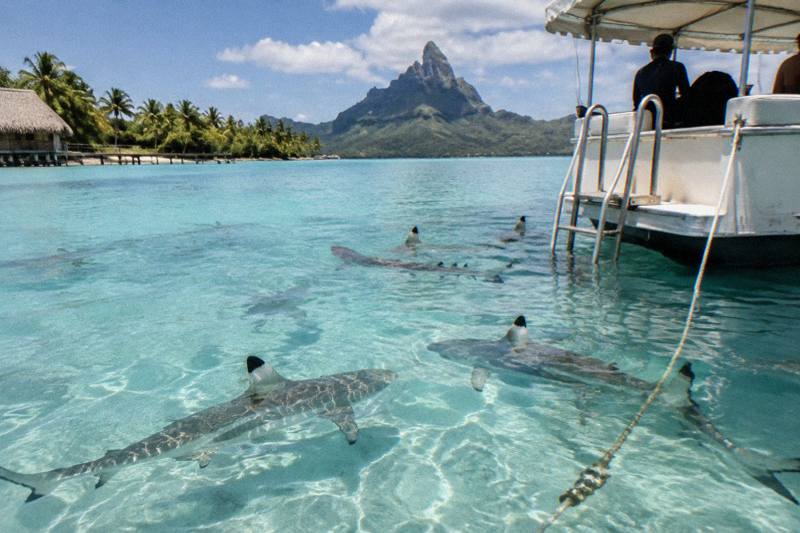
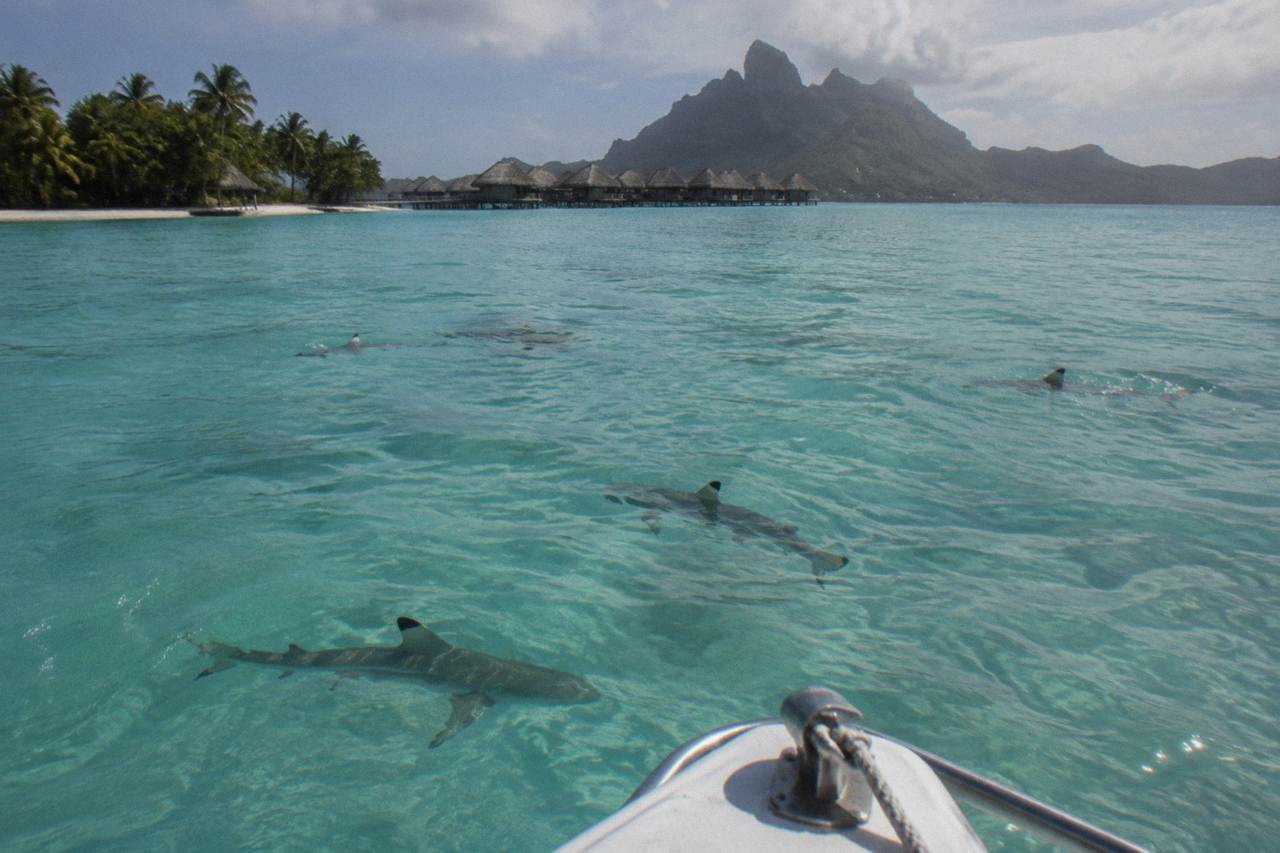
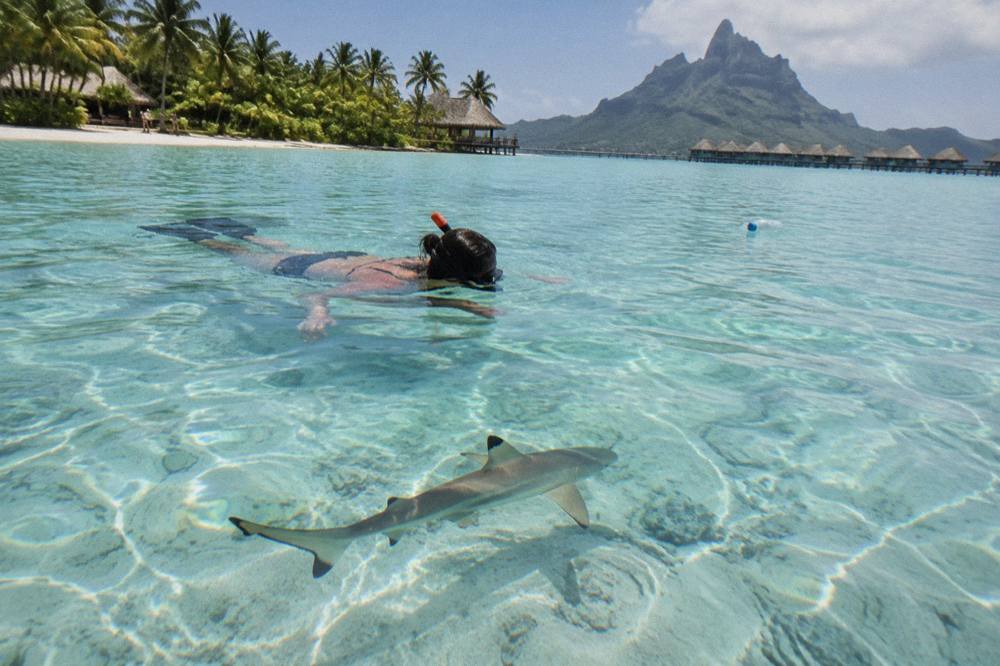
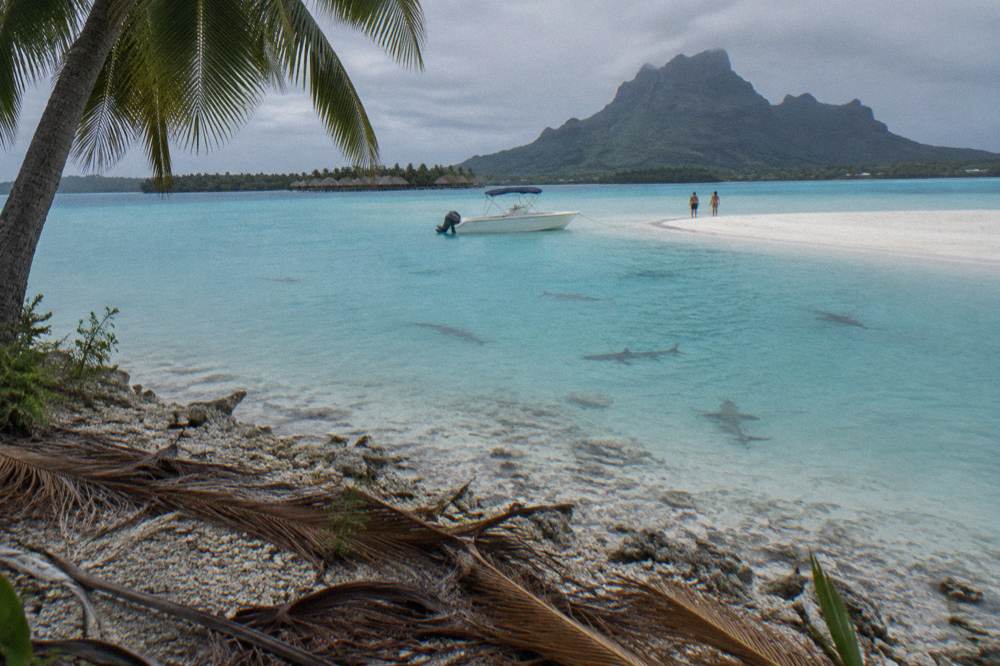
The blacktip reef shark is the animal in the photos. It is the slim, pale shark with the dark fin tips that circles the shallow sandbars where tour boats anchor, and it spends its life in water shallow enough to stand in. Operators and regional guides describe it as the most common species encountered on Bora Bora lagoon tours. Size matters here: an adult blacktip at the top of the typical range is about as long as a ten-year-old child is tall, and it is built for hunting small reef fish, not large prey.
Lemon sharks are the second name that comes up. They are bulkier, yellowish, and reach about 3 m in the wider literature, and guides note they appear occasionally in the deeper parts of the lagoon rather than at the shallow snorkel stops. A snorkeler on a standard tour may well go a whole week without one showing up. The listing pages do not sell lemon shark encounters, and neither should any expectation you carry onto the boat.
What does not live in the lagoon swim is the set of species people actually fear. The large open-ocean sharks that dominate documentaries hunt in deep water outside the reef, and the lagoon's shallow, enclosed character is precisely why families and cautious swimmers are taken there. The Bora Bora Snorkeling Tours lineup reflects that: not one listing markets itself on large or aggressive species, because none of them structure the encounter.
It is worth being precise about what "typical" means in those size figures. The 0.5 to 1.5 m range for blacktips comes from operators and regional guides, not from a census, and individual animals vary. The range is a planning figure that tells you the animal you are likely to meet is modest in size, not a guarantee of what swims past on any given morning. The same honesty applies to sightings themselves: sharks move, weather shifts, and no listing on this site promises an encounter.
How Do Blacktip Reef Sharks Behave Around Snorkelers?
Guides and regional sources describe blacktip reef sharks as uninterested in snorkelers unless deliberately provoked, and stingrays as defensive only when stepped on or grabbed. No credible source calls any wild shark risk-free, and this article will not either. The recorded pattern is avoidance and indifference: the sharks circle at distance, keep their spacing, and treat a group of floaters as scenery rather than food.
Behavior is where the safety question actually gets decided. A regional guide to Polynesian rays and sharks describes blacktips as harmless to swimmers unless deliberately provoked, and the practical translation of that phrase is simple: do not grab, chase, corner, or touch the animal, and the animal has no reason to treat you as anything but a large, noisy neighbor. The provocation caveat is not legal boilerplate. Almost every negative shark interaction recorded anywhere involves a fed, grabbed, or cornered animal.
Stingrays share the stop and have their own rule. The defensive barb in the tail is used when the ray is stepped on or grabbed, so the standing advice is to shuffle your feet in sandy shallows and let guides handle any close interaction. That shuffle is the single most repeated instruction in the safety briefings, and it exists because rays lie buried in exactly the sand where guests wade.
The vertical distance rule for rays is different from sharks. Rays such as mantas at cleaning stations are approached at the surface, staying calm and horizontal, never diving down, never blocking the animal's path; the fuller etiquette for manta sites is covered in the Bora Bora manta rays guide. Blacktips and stingrays at the shallow stops follow a simpler script that any guide will repeat before you enter the water.
| Animal | Typical behavior near snorkelers | What guides ask of you |
|---|---|---|
| Blacktip reef shark | Circles at distance, indifferent to floaters | No chasing, no touching, no reaching |
| Stingray | Rests on sand, moves off when approached | Shuffle feet, never grab the tail |
| Lemon shark | Occasional in deeper lagoon areas, keeps distance | Stay with the group, follow the guide |
None of this amounts to a promise of safety, and the language of the region's own guides stops short of one. What it amounts to is a body of consistent observation: these are small, shy, legally protected animals, the tours that visit them have run for years under the same rules, and the behavior briefings guests receive are short precisely because the required conduct is simple. The deeper discussion of species and incident record continues in the dangerous sharks in Bora Bora article, which separates the lagoon species from the open-ocean ones people actually fear.
What Are The Shark Rules In French Polynesia?
French Polynesia has protected all shark and ray species in its waters since 2006, and the Environmental Code states that any attempt to attract sharks, or any action likely to modify their behavior, is strictly prohibited. This is the world's largest shark sanctuary. Tours may bring guests to places sharks naturally gather, and the law draws the line at manipulating the animals to intensify the encounter.
The sanctuary matters for a snorkeler in two ways. First, the animals you meet are the beneficiaries of two decades of nationwide protection, which is part of why they are present in the lagoon at all. Second, the prohibition on attraction and behavior modification means the legal ceiling on how far an operator can push an encounter is low, and that ceiling works in the guest's favor. A tour that cannot bait or chum is a tour built around finding sharks where they already are.
The industry's response to that law varies, and the listings are honest about the split. Some operators run explicitly eco-framed products that state a no-feeding policy and visit natural congregation areas instead; the eco shark and snorkel safari from Moana Adventure Tours, from $107 per person, is one such product, and independent guides note that operator's eco safari runs three stops, a coral garden, rays, and blacktips, without feeding. Other operators have historically fed at ray stops, a practice regional guides report is now limited or controlled to balance tourism with conservation. What this site prints is only what each listing states: where a listing claims an eco no-feeding approach, that claim is reported as the operator's own.
For the swimmer, the rules translate into a short list of conduct that is partly law and partly etiquette:
| Rule or norm | Source | Effect on you in the water |
|---|---|---|
| All sharks and rays protected | Environmental Code, in force since 2006 | Touching or harassing is illegal, not just rude |
| Attracting or modifying shark behavior prohibited | Environmental Code | Tours visit natural gathering spots |
| No-feeding policies stated by some eco operators | Operator listings | Choose an eco listing if this matters to you |
| Guides brief and supervise every stop | Standard practice across the lineup | Follow the briefing, stay with the group |
There is a caveat the honest version of this article has to carry: enforcement and practice at sea are not the same as text in a code. The law sets the boundary, operators position themselves against it, and a guest's best protection is choosing a listing whose stated approach matches their comfort, then following the guide's instructions in the water. The swim with sharks and rays guide walks through that choice in more depth.
What Actually Happens On A Shark And Ray Snorkel Stop?
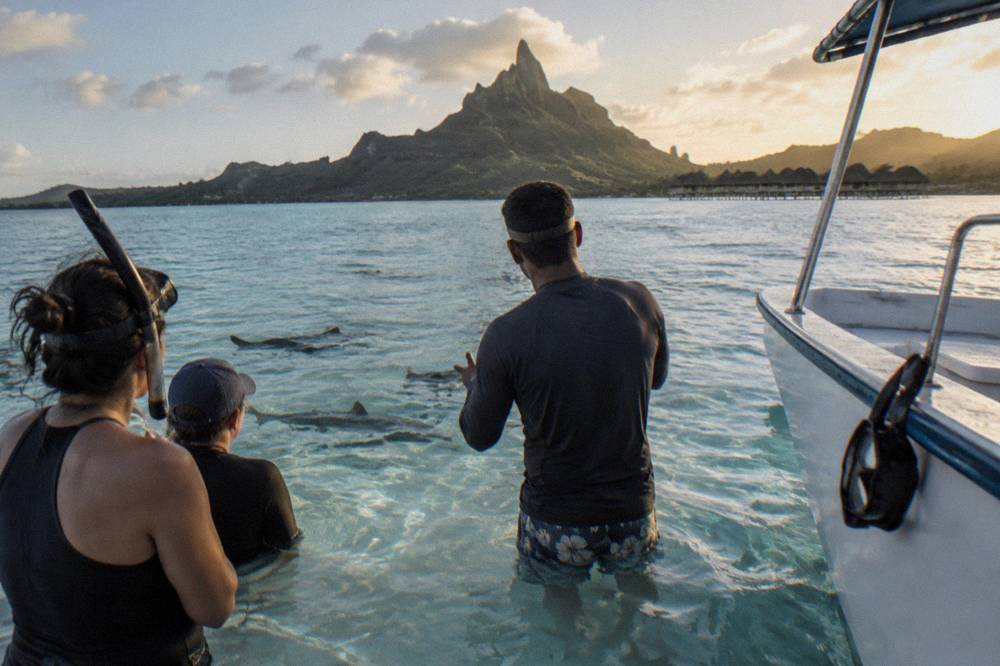
The boat anchors over shallow sand, the guide briefs the group on conduct, and guests enter the water in life jackets or with flotation if they want it, floating in a loose cluster while sharks and rays circle at their own chosen distance. Guides supervise throughout. Non-swimmers are explicitly welcomed by several operators, including H2O Bora Bora and O-Sea Bora Bora, whose own FAQ pages state they adapt to all swimming levels.
The mechanics are deliberately undramatic. The water at the ray and shark sandbars is shallow enough that standing is often possible, the boats anchor within sight of the group, and the animals arrive or do not on their own schedule. The guide's role is part safety, part narration: pointing out animals, keeping the group together, and intervening if anyone drifts toward the reef edge or crowds an animal. Guests who prefer to watch from the boat can do so; every listing describes the stops as optional.
The shark stop sits inside a longer circuit on every lineup product that includes one. On the eco cruise from Moana Adventure Tours, it is one element of a 2.5-hour outrigger canoe route that also covers stingrays and reef; the jet ski combo strings it after a morning of riding, with lunch included; the Rohivai full-day lagoon safari, from $170 per person with a 4.9 rating from 825 reviews, places the shark and ray swim between a coral garden snorkel and a Polynesian picnic on a motu. The stop is the same in each case; the packaging around it differs.
What the stop does not involve, on any listing on this site, is a cage, a weapon, or any apparatus of control. There is no equipment because none is needed: the animals are small, the water is shallow, the group is supervised, and the entire design of the stop assumes indifference on both sides. Guests who want a longer read on the wider experience can start with the Bora Bora lagoon tour guide, which situates the shark stop inside the full circle-island day.
Which Tours Include A Shark Snorkel Stop?
The shark and ray stop appears across every tour family in the lineup: half-day eco cruises from $107 to $112 per person, full-day lagoon safaris with motu lunch from $154 to $194 per person, and combos adding jet skiing or 4WD from $158 to $432 per person. Ratings run from 4.5 to 5.0, with review counts from 84 to 825. Choosing between them is a question of time and budget, not safety.
The half-day options are the low-commitment entry. The eco snorkel cruise with sharks and stingrays from Moana Adventure Tours, from $112 per person, rated 4.8 from 604 reviews, runs 2.5 hours by outrigger canoe with pickup and snorkel gear listed. The eco shark and snorkel safari from the same operator, from $107 per person and rated 4.7 from 191 reviews, covers three stops in the same 2.5 hours. Both list free cancellation; the cruise listing includes gear, while the safari's listing does not state gear, so check the live listing before assuming.
Full-day products wrap the same stops in a longer day. The Vavau 4x4 Adventures lagoon cruise with sharks and stingrays, from $154 per person and rated 4.8 from 734 reviews, includes lunch, and the Rohivai full-day safari with motu lunch, from $170 per person, is the category's most reviewed listing at 825 reviews. The combos add land or speed: the 4WD and eco shark ray cruise from $246 per person, and the jet ski and eco shark ray cruise from $303 per person, rated 4.8 from 391 reviews.
| Listing | Duration | From (USD) | Rating and reviews |
|---|---|---|---|
| Eco snorkel cruise with sharks and stingrays | 2.5 hours | $112 per person | 4.8 from 604 |
| Eco shark and snorkel safari | 2.5 hours | $107 per person | 4.7 from 191 |
| Full-day lagoon cruise with sharks and stingrays | 6 hours | $154 per person | 4.8 from 734 |
| Full-day lagoon safari with motu lunch | 6 hours | $170 per person | 4.9 from 825 |
| Jet ski tour and eco shark ray cruise | 6.5 hours | $303 per person | 4.8 from 391 |
Every one of these is a shared or small-group product; none is sold as a whale-watching trip, and none should be expected to become one. The whale season runs July to November and is regulated separately, with approved providers keeping 100 m distance, and no listing is a whale product. For readers weighing group versus private formats, the private versus group lagoon tour guide compares the two; the private boat from H2O Bora Bora, from $650 per group for 3.5 hours, rated 5.0 from 126 reviews, runs the same shallow stops on your own schedule.
One honest note on the ratings in that table: they describe guest satisfaction, not safety, and a 4.8 from 604 reviews tells you the tour delivered a good morning, not that the ocean was tamed. The safety case rests on the material covered above, the species, the law, and the conduct of the stop. The listings do the delivering; the regulation does the protecting.
The fear that stops most people from booking is a fear of the wrong animal in the wrong place. The shark at a Bora Bora sandbar stop is a small, protected, legally off-limits-to-baiting reef species that has circled tour groups for years without incident beyond the rare provoked one. The is it safe to swim in Bora Bora question covers the broader water-safety picture, currents, and the non-shark risks that genuinely deserve planning attention. Choose a listing whose stated approach you trust, wear the flotation if you want it, shuffle in the sand, and let the animals keep their distance, which is what they were going to do anyway.
Common Questions About Swimming With Reef Sharks In Bora Bora
What should I know about the risks of snorkeling with reef sharks on a Bora Bora tour?
In the setting tours actually provide, yes: a guided, shallow stop with blacktip reef sharks, typically 0.5 to 1.5 m, supervised by a briefing and a guide in the water. Guides describe the species as indifferent to snorkelers unless provoked. No source honestly calls any wild shark risk-free, so follow the briefing, keep your distance, and do not touch.
Do reef sharks pose any danger to swimmers at the guided lagoon stops?
Reef sharks on guided lagoon stops are described by operators and regional guides as harmless to swimmers unless deliberately provoked, and the incident record for these supervised encounters is very thin. The safe version of the experience is the one the listings sell: shallow water, a guide, a group, and no grabbing, chasing, or feeding.
Can you touch or feed the sharks on a tour?
No. All sharks and rays have been protected in French Polynesia since 2006, and the Environmental Code prohibits any attempt to attract sharks or modify their behavior. Some eco-framed listings state a no-feeding policy explicitly and visit natural congregation areas; touching or harassing the animals is illegal regardless of the operator.
How big are the sharks at the Bora Bora snorkel stops?
The blacktip reef shark, the species guides describe as the common one on lagoon tours, typically runs 0.5 to 1.5 m. Lemon sharks, which appear occasionally in deeper lagoon areas, can reach about 3 m but are not a routine sighting at shallow snorkel stops.
Do I need to be a strong swimmer to do the shark stop?
No. The stops are shallow and supervised, life jackets and flotation are provided by operators such as H2O Bora Bora and O-Sea Bora Bora, whose own FAQ pages state that non-swimmers are welcome and tours adapt to all swimming levels. You can also stay on the boat; the stops are optional on every listing.