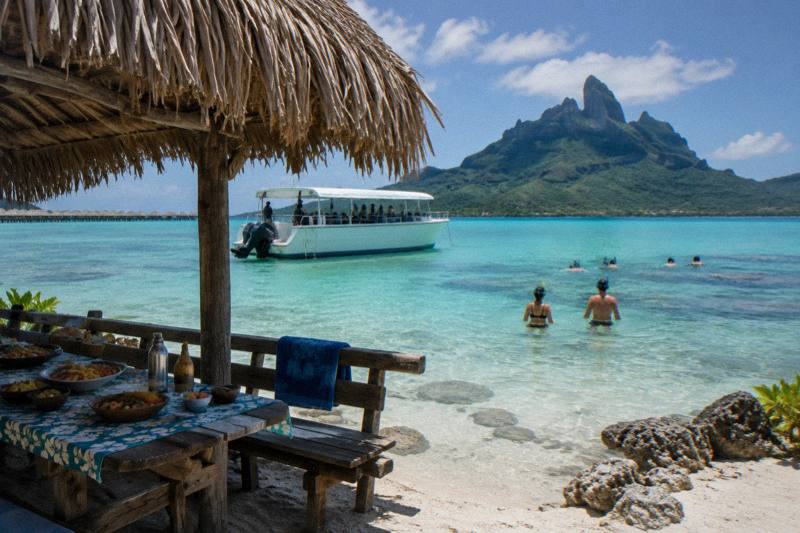
Is Bora Bora Worth The Money?
Bora Bora costs more than almost any other island in the South Pacific, and the question every first time visitor asks is whether the lagoon justifies the bill. This guide stacks the real numbers against what you actually get.
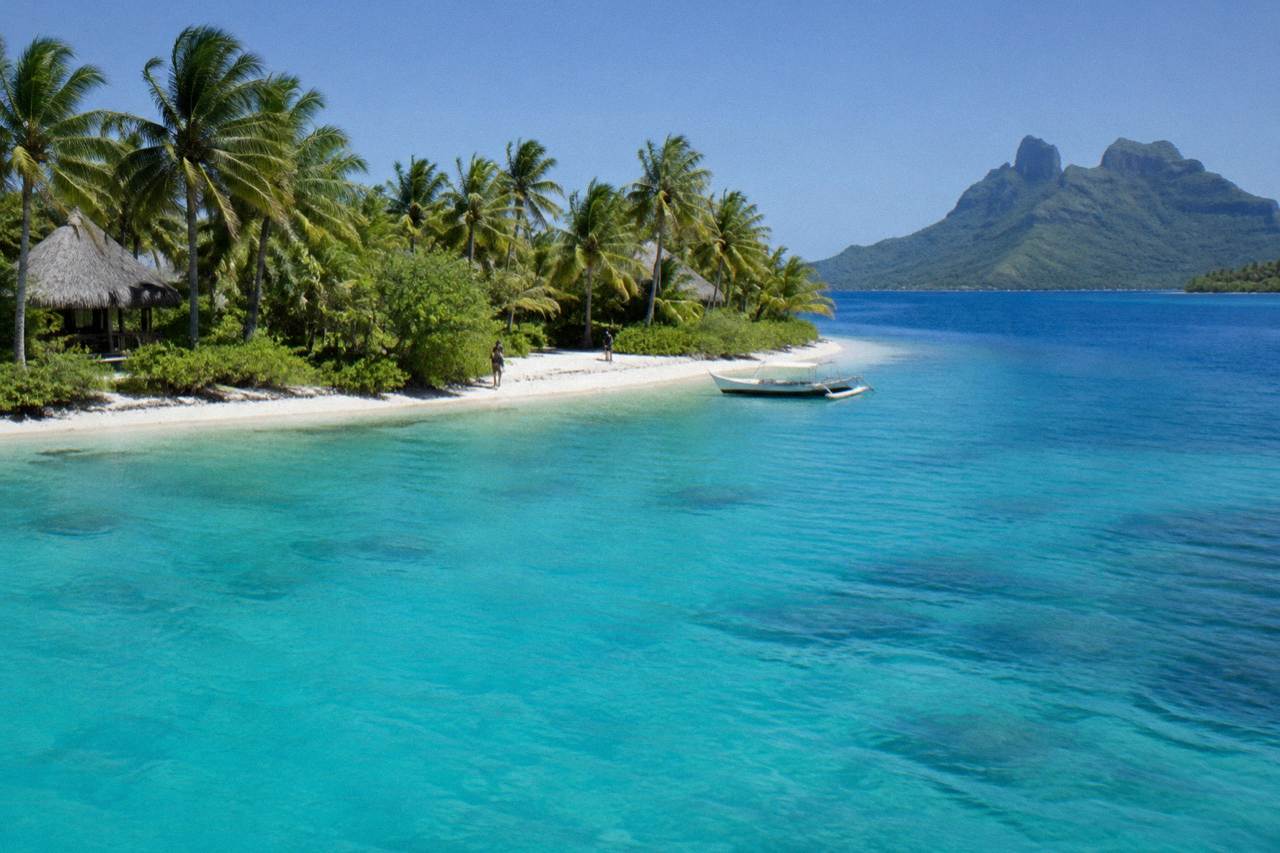
Short answer
For most first time visitors, yes. Bora Bora is expensive: hotel nights, food and flights set the floor, while the lagoon itself is free to look at and cheap to reach by boat tour, from $105 per person on this site's lineup. The water, the motu and the reef life are the reason the bill is worth paying.
Is Bora Bora Really Worth It?
For most first time visitors, yes, and the reason is narrow and specific: the lagoon. The island's hotels and restaurants are expensive everywhere in French Polynesia, but only Bora Bora pairs them with a turquoise, reef protected lagoon where sharks, rays and dense coral gardens sit minutes from your dock. Travelers who come for the water rarely regret the trip. If you're wondering whether Fiji delivers similar water for less money, our comparison of Fiji and Bora Bora snorkeling and costs takes an honest look at both.
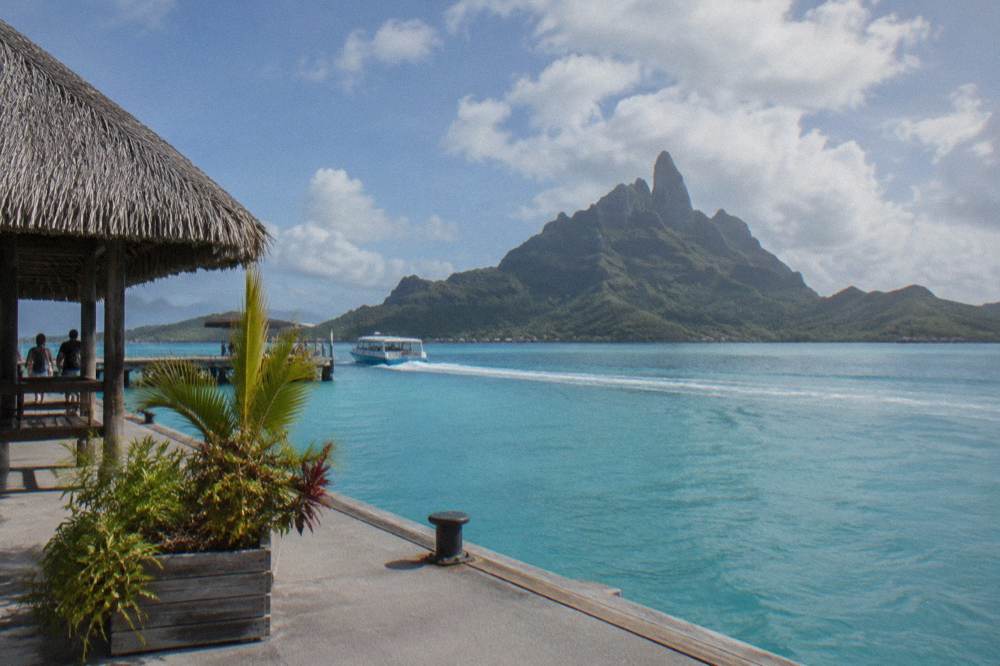
The honest version of the answer starts with what Bora Bora is. It is a small island, 30.55 square kilometers, ringed by a barrier reef and a handful of palm covered islets, the motu, that hold most of the resorts. Mount Otemanu, at 727 meters, anchors the skyline, and a 32 kilometer ring road circles the main island in about 45 minutes of non stop driving. None of that is unusual for the Society Islands. What is unusual is the water inside the reef: shallow, warm all year, and full of reef life that boat tours reach within minutes of leaving the dock.
French Polynesia as a whole is managing itself as a high value destination rather than a volume one. The territory recorded roughly 281,227 visitors in 2025, up 6.6 percent on the year before, and official strategy favors sustainable, higher spending travel over unlimited growth. That context matters for anyone asking the worth-it question, because the price level is policy, not accident. A report on the territory's tourism strategy spells out the shift.
The pattern we see across the site's research is consistent. Visitors who book two or three lagoon days, a half day snorkel, a full day with a motu lunch, maybe a sail, come home calling the trip worth it even when they wince at the dinner bills. Visitors who stay on land and look at the water from a lounger tend to feel they paid resort prices for a view. The lagoon is the product. This guide stacks the costs against the reward so you can decide which side of that line you will land on. When you know which side of the line you want to land on, the ranked guide to things to do in Bora Bora beyond the resort covers which lagoon tours earn their price, where to swim from shore for free, and how to time a full day on the water.
Is Bora Bora Really Expensive?
Yes, by almost any comparison. Hotel rates in the dry season, resort food prices and the inter island flight stack up fast, and a per person per night visitor tax applies on top. But the expense is concentrated in sleeping and eating: the island's signature experience, a lagoon snorkel tour, starts from $105 per person on this site's lineup, cheaper than a single resort dinner for two. If you're weighing whether a different island in the group could give you similar water for less money, our comparison of Tahiti and Bora Bora for snorkelers looks at the lagoons, the costs and the logistics side by side.
Break the question apart, because "expensive" hides three different bills. The flight bill: Bora Bora has no ferry from Tahiti, so the connection is by air, roughly 50 minutes from Papeete on domestic carriers. The bed bill: overwater bungalows and resort nights on the motu set the price floor, and July and August are the peak, most expensive months. The activity bill: this is the part that surprises people, because it is the cheapest layer of the trip.
The tax layer is small but real. The overnight stay tax in force until the end of 2026 runs at 200 XPF per person per night at classified hotels and cruise ships, and 50 XPF at guesthouses and rentals, collected by the provider. The commune publishes the current taxe de séjour rates on its official page. Rates are changing in 2027, check the commune before you travel.
| Cost layer | What drives it | Typical planning reality |
|---|---|---|
| International flight to Papeete | Route and season | Set by origin city, not by Bora Bora |
| Papeete to Bora Bora flight | No passenger ferry exists | About 50 minutes, daily domestic services |
| Accommodation | Motu resorts versus mainland pensions | Peak pricing in July and August |
| Food | Resort dining versus Vaitape eateries | The biggest flexible line in most budgets |
| Lagoon tours | Shared, small group or private boat | Lineup runs from $105 per person |
| Visitor tax | 200 XPF per night at hotels, 50 XPF at pensions | Collected by the provider |
Notice what the table does not contain: an entry for the lagoon itself. Matira Beach, the island's only public beach, is free to access, with no gates or resort requirement, and its shallow water is shore snorkelable with your own gear. The public status of Matira is confirmed in current guides. The expensive parts of Bora Bora are the parts you sleep and eat in. For a fuller breakdown of the free and cheap layer, see our free things to do in Bora Bora guide.
What Does The Lagoon Actually Give You For The Money?
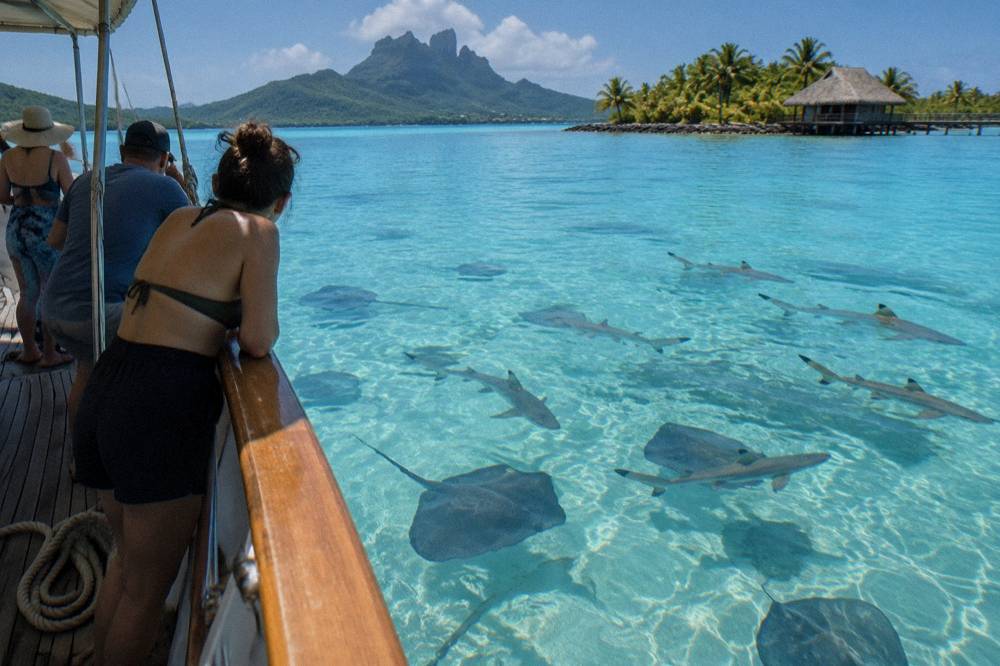
What the money buys is density: sharks, rays, coral gardens and manta cleaning stations all inside one calm, warm lagoon, reached by boats that leave from resort docks and the Vaitape quay. A half day covers coral gardens and ray encounters. A full day adds a motu lunch and the circle of the lagoon. No shore based activity on the island replicates it.
The lagoon's sites are boat territory. The Anau manta ray cleaning station on the east side is described in current operator guides as reachable only by tour, with no recommended shore access, because of private property, currents and reef protection. The southern coral gardens and the spot known as the Aquarium are boat stops on standard lagoon circuits. Matira is the one shore option, and it is genuinely good, but the deeper catalog of the lagoon belongs to the boats.
This is why the worth-it math works differently than on beach destinations where the headline experience is free. In Bora Bora the headline experience is a tour, and tour pricing is the number that should drive your decision more than the hotel rate, because it is the layer you control most easily and the layer that delivers the thing you came for. On this site's lineup, the most reviewed listing of all is the full-day lagoon group tour with lunch from Lagoon Service: 5.0 from 1,715 reviews, from $173 per person for six hours, with pickup, gear and a meal listed. You can read the full breakdown in our Bora Bora lagoon tour guide, and you can check dates on that full-day listing from its card below.
These listings frame the real choice. A full day with lunch for the complete circuit, a half day for the compact version, or a catamaran sail if you want the lagoon with wine and a deck rather than a mask and fins. Every one of them lists pickup and free cancellation, which matters when you are booking months ahead of a trip this size.
There is one piece of fine print that affects the value question. Since December 2025, a 574 hectare no take zone, the Popora rahui, has closed the southern reef off Matira to all fishing, boating and nautical activity. It is French Polynesia's first fully protected lagoon zone of its kind. Tours do not enter it, and the protected band is one reason the island's reef story is being managed for the long term rather than mined for short term volume.
How Much Does A Bora Bora Snorkel Tour Cost?
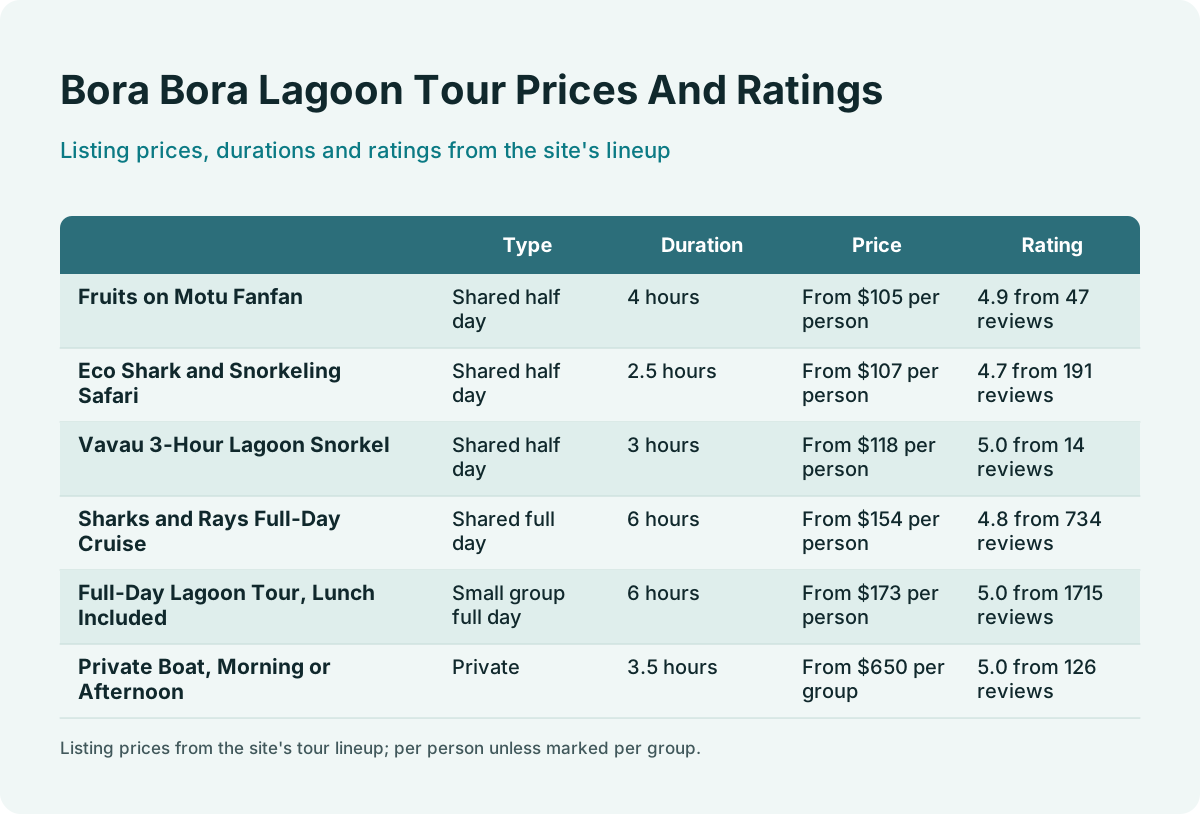
Shared half day lagoon tours on this site's lineup run from $105 to $151 per person for roughly three to five hours. Full day tours with a motu lunch run from $144 to $224 per person. Private boats start from $560 per group, and the luxury end, a private full day with a lunch served in the water, reaches from $1,776 per group.
Those are listing prices, not estimates, and they are the numbers to plan around. The cheapest listing is the Half-Day Bora Bora Experience with Fruits on Motu Fanfan, from $105 per person, 4.9 from 47 reviews, four hours with a fruit stop on a private islet. At the other end of the shared scale, the Blue Lagoon cruise from Teina Tuaiva, an English only full day, runs from $224 per person.
| Tour | Type | Duration | Price | Rating |
|---|---|---|---|---|
| Fruits on Motu Fanfan | Shared half day | 4 hours | From $105 per person | 4.9 from 47 reviews |
| Eco Shark and Snorkeling Safari | Shared half day | 2.5 hours | From $107 per person | 4.7 from 191 reviews |
| Vavau 3-Hour Lagoon Snorkel | Shared half day | 3 hours | From $118 per person | 5.0 from 14 reviews |
| Full-Day Lagoon Tour, Lunch Included | Small group full day | 6 hours | From $173 per person | 5.0 from 1715 reviews |
| Sharks and Rays Full-Day Cruise | Shared full day | 6 hours | From $154 per person | 4.8 from 734 reviews |
| Private Boat, Morning or Afternoon | Private | 3.5 hours | From $650 per group | 5.0 from 126 reviews |
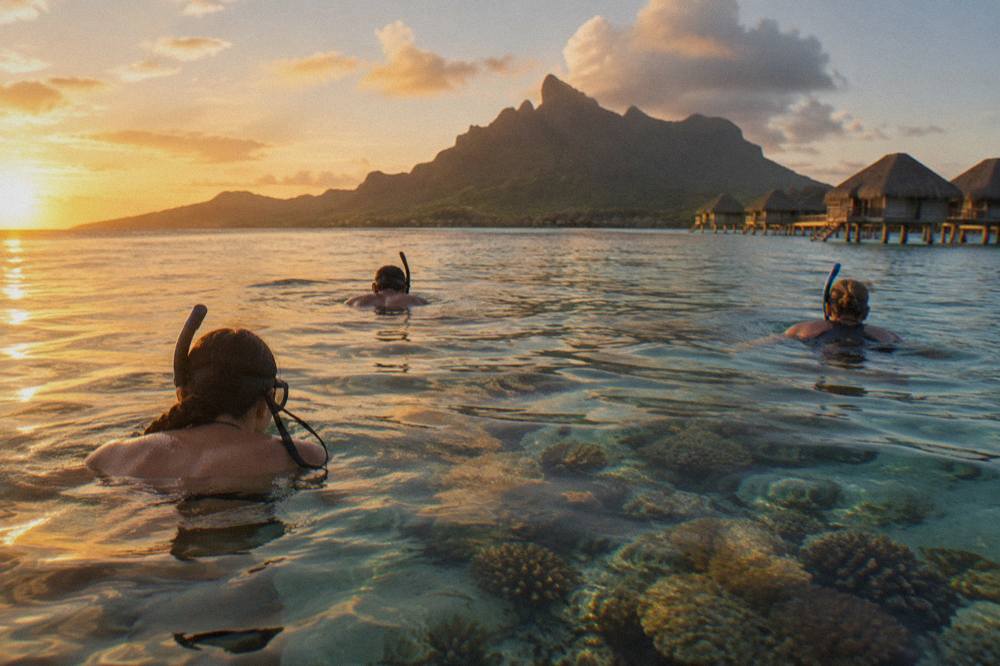
Between the cheapest half day and the priciest full day sits a band of options that differ mainly in length, group style and whether food is included. The Reef Discovery Half Day Group Signature Tour, from $134 per person for three and a half hours, is the most reviewed half day in the lineup, 5.0 from 1,051 reviews, and it circles the lagoon with stops at the signature sites. We compared the listings, and the honest summary is that price tracks hours and lunch more than quality: several of the cheapest options carry ratings in the high 4s and low 5s.
For the budget side of the question, our Bora Bora snorkeling cost guide breaks down every category in the lineup, including the jet ski combos and the private catamarans, and the private versus group lagoon tour comparison works out when a private boat stops being a luxury and starts being simple arithmetic for a family of five or six.
Can You Do Bora Bora On A Budget?
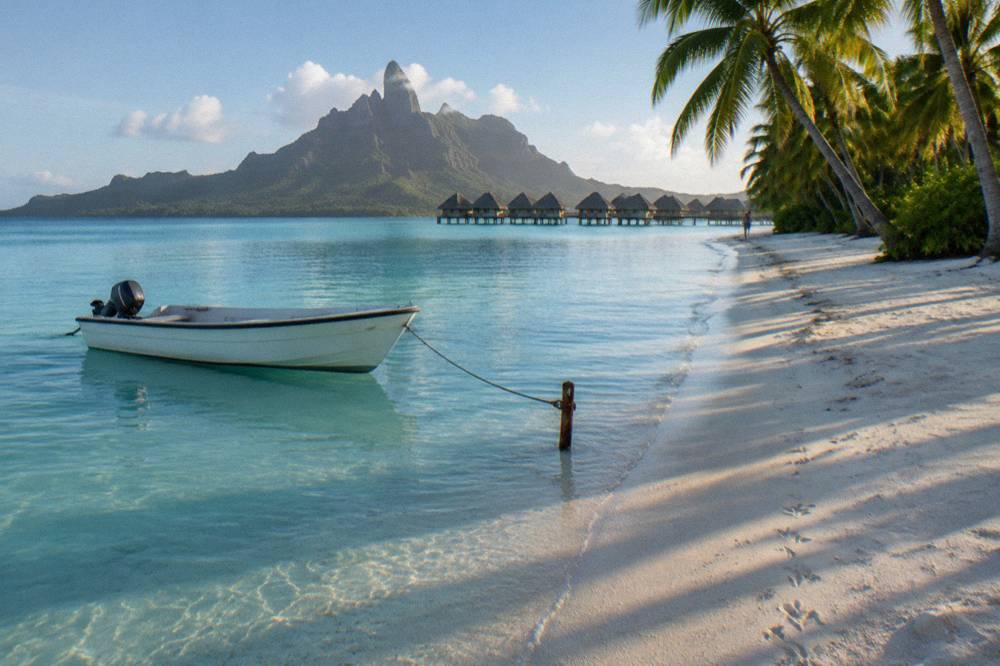
Partly, yes, and the savings come from three moves: stay on the main island rather than a resort motu, eat in Vaitape rather than at resort restaurants, and book one or two shared lagoon tours rather than a private boat. The lagoon experience itself is not gated behind resort rates, because every shared tour in the lineup picks up from the Vaitape quay.
The structural fact that makes budget Bora Bora possible is that the product, the lagoon, is rented by the boat seat, not by the room. Guesthouses on the main island pay the 50 XPF tax tier instead of 200, the ring road connects everything in under an hour, and the tours pick up from 18 or 19 locations each, including the quay at Vaitape. You can sleep cheap, eat local and still swim with blacktip reef sharks over the same coral gardens the resort guests pay five times more to look at. If a mask and fins already put you over that same reef, the next question is whether a tank adds anything, and our honest guide to scuba diving in Bora Bora compares the two honestly.
The free layer is real too. Matira Beach is public and free, its shallow water is shore snorkelable, and the ring road's viewpoints of Mount Otemanu cost nothing but a scooter rental. What the free layer cannot do is reach the manta cleaning station, the outer coral gardens or a motu lunch, and no research on file found any free walking tour alternative anywhere in French Polynesia. For the lagoon's signature sites, a boat is the only route, and the cheapest boat seat in the lineup is from $105 per person.
The eco shark and snorkeling safari from Moana Adventure Tours is the short, sharp version of that entry point: 2.5 hours, from $107 per person, 4.7 from 191 reviews, with pickup and free cancellation listed. For a first timer deciding whether the lagoon lives up to the pictures, it is the lowest cost genuine test.
Cruise passengers get a version of the same arbitrage. Ships anchor in the lagoon and tender to the Vaitape quay, a ride of typically 15 to 20 minutes, and independent tours pick up right there. Ship sponsored excursions generally price above independent equivalents for comparable itineraries. Our cruise shore excursions guide works through the port logistics in full.
When Is Bora Bora Worth It Most?
May to October, the dry season, is when the island earns its price: rainfall drops from 245 mm in January to between 61.9 and 64.6 mm across July to September, rain days fall from 17 to about 9, and operators and guides describe the calmest, clearest lagoon conditions then. July and August add peak crowds and peak rates; May, June, September and October deliver similar water with fewer people.
The climate record behind that comes from the Meteo France station at Bora Bora's airport islet, and the pattern is unambiguous. The wet season, November to April, carries double the rainfall of the dry months, with the tradeoff of warmer water. A sea temperature series puts the lagoon between 26.7 and 28.9 degrees Celsius across the year, so cold is never the issue in Bora Bora, only rain and chop.
| Month | Rainfall (mm) | Rain days (1 mm or more) | Max temp context |
|---|---|---|---|
| January | 245.0 | 17.2 | Wet season, warmest water |
| March | 168.1 | 14.5 | Wet season |
| May | 112.0 | 11.4 | Dry season begins |
| July | 61.9 | 9.4 | Driest month, peak season |
| September | 64.6 | 9.3 | Dry, shoulder crowds |
| December | 250.7 | 16.8 | Wet season returns |
July to November is also the humpback whale season per Tahiti Tourisme, though no listing in this lineup is a whale watching product, and snorkel tours do not promise whales. Approach rules are strict: approved providers keep 100 meters, three knots within 300 meters, parallel courses, no encircling. The season is background texture, not a booking promise.
For the full month by month picture, including water temperatures and what they mean for visibility, see our best time to snorkel in Bora Bora guide. The short version for the worth-it question: the island is at its most convincing between May and October, and at its cheapest in the shoulder months either side of the July August peak.
What Do Visitors Actually Say About The Value?
The review pools on this site's lineup are unusually strong for a mass market product: the featured full-day lagoon tour holds 5.0 from 1,715 reviews, the most reviewed listing in the lineup, and several half days hold 5.0 or the high 4s across hundreds of reviews. The consistent thread in guest feedback is that the lagoon day, not the hotel, is the memory that survives the credit card bill.
Read the pattern rather than any single quote. The three most reviewed listings in the lineup, the full-day lagoon tour with lunch at 1,715 reviews, the Reef Discovery half day at 1,051, and the Rohivai full-day lagoon safari at 825, all sit at 4.9 or 5.0. That is a large sample of people who paid the money and rated the water. It does not make the hotel rates defensible, and this site does not review hotels. It means the layer of the trip you can actually buy well, the lagoon day, is delivering.
The counterweight is worth stating plainly. Bora Bora punishes passivity. Travelers who book the room and nothing else report the island as beautiful and inert, because the reef, the rays and the motu are on the other side of a boat ride. The value failure mode is not overspending on tours, it is underspending on them relative to the room.
The luxury tier answers a different question. The catamaran sail with a floating bar, from $309 per person for four hours under sail with snorkeling, 4.9 from 164 reviews, is the lineup's clearest "this is the splurge" listing. It is not better value than the shared half days, it is a different product: deck, drinks and rigging instead of maximum water time.
Safety questions come up alongside value ones, and the answers are reassuring. French Polynesia has protected all shark and ray species in its waters since 2006 under the Environmental Code, which prohibits attracting sharks or altering their behavior. Blacktip reef sharks, typically 0.5 to 1.5 meters, are the species commonly described on lagoon tours, guides brief guests, and non swimmers are explicitly welcomed by operators with flotation and supervision. Our pieces on swimming with reef sharks and on non swimmers cover the detail.
So Is Bora Bora Worth The Money?
Yes, if the lagoon is the point of the trip and you budget for it deliberately: one full day with a motu lunch, one or two half days, and a main island or guesthouse base. No, if the plan is a resort room and a view, because the view is free and the room is not. The verdict turns on whether you actually get in the water.
Every layer of this guide points the same way. The flight and bed costs are fixed and high, and no research on file makes them smaller. The activity layer is cheap relative to the trip, from $105 per person for a genuine half day on the water, and it is the layer that contains everything the island is famous for. The weather argument resolves to May to October, ideally the shoulder months. The review record says the boats deliver.
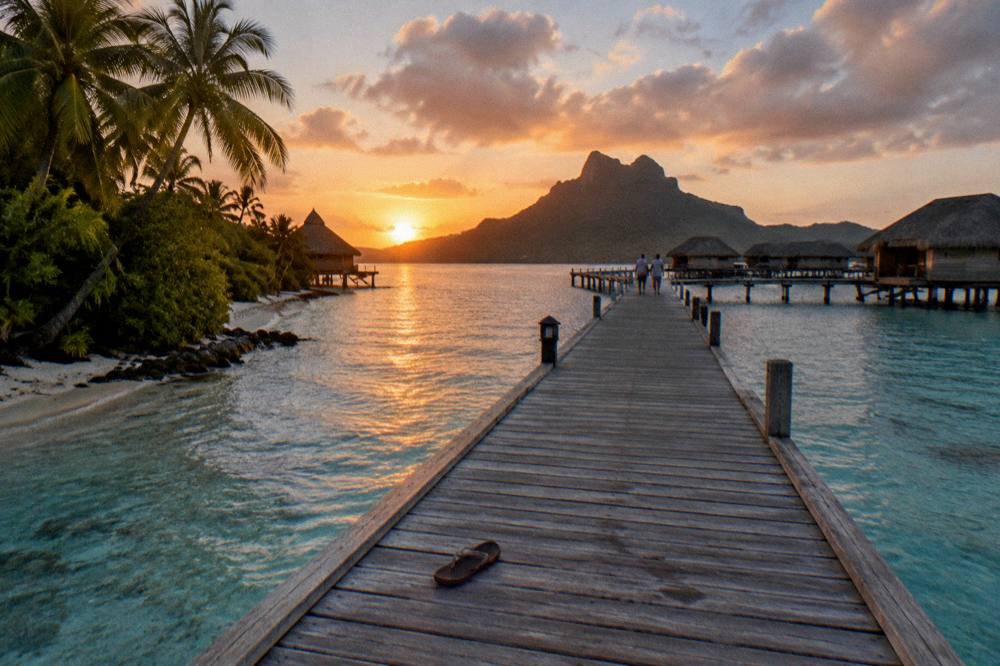
The planning arithmetic we would run for a first visit: two lagoon days, one full day with lunch to circle the reef and meet the rays and sharks, one half day or a sail for variety, plus free time at Matira and the Vaitape waterfront. At prices that activity stack costs less than a single night in many dry season rooms, and it is the part of the trip you will still be describing in five years. That is the honest case for Bora Bora Snorkeling Tours as the organizing principle of the visit rather than an afterthought to it.
Common Questions About Whether Bora Bora Is Worth It
Is Bora Bora really worth it?
For most first time visitors, yes, if the lagoon is the focus. The water, reef life and motu are the island's unique product, and they are reached affordably by shared boat tours from $105 per person. Visitors who stay on land and skip the water often feel the price was not justified.
Does a Bora Bora trip give you good value for the cost?
The bed and food bills are high and fixed, but the experience layer is cheap relative to the trip. A full day lagoon tour with a motu lunch, the most reviewed listing in the lineup at 5.0 from 1,715 reviews, runs from $173 per person with pickup, gear and a meal, less than many single resort dinners for two.
Is Bora Bora really expensive?
Sleeping and eating, yes: resort rates peak in July and August, and food is the biggest flexible line. The lagoon itself is not gated, Matira Beach is free and public, and shared snorkel tours start from $105 per person with pickup from the Vaitape quay.
When is Bora Bora cheapest?
The shoulder months of May, June, September and October carry dry season conditions with fewer crowds and lower rates than the July and August peak. Rainfall bottoms out in July at 61.9 mm against 245 mm in January.
Can you enjoy Bora Bora without a resort budget?
Partly. Guesthouses on the main island, the 50 XPF tax tier, Vaitape eateries and free public time at Matira cut the fixed costs, and every shared tour picks up from the quay. The boat only sites like the manta cleaning station still require a tour.
How many lagoon days should a first visit include?
Two is the sweet spot: one full day with a motu lunch to circle the lagoon, plus one half day or a catamaran sail. At prices that stack costs between roughly $300 and $480 per person and covers the coral gardens, rays, sharks and reef fish the island is known for.