Best Time To Snorkel In Bora Bora
The dry season from May to October brings the lowest rainfall and the calmest lagoon, but every month of the year has workable water and a bookable tour. Here is how to time it.
Short answer
The best window is May to October, the dry season, when Bora Bora records its lowest rainfall (61.9 to 112 mm per month) and operators describe the calmest, clearest lagoon. Humpback whale season runs July to November. July and August are the busiest and priciest months; May, June, September and October offer similar water with fewer crowds.
Sharks and rays do not keep a calendar, but weather does. The Bora Bora lagoon sits inside a reef that flattens the ocean's energy most of the year, which is why every one of the 34 tours in this lineup runs in every month, yet the difference between a February afternoon and a September morning is real enough that timing changes which tour you should book. The question is not whether you can snorkel in Bora Bora, it is which month, which time of day and which boat make the water work hardest for you. To see exactly how warmth, rain and wind shift through the year, our month-by-month guide to Bora Bora water temperature and visibility pairs each season with the lagoon tours that fit it.
The short version: the dry season from May to October delivers the lowest rainfall and the calmest conditions, July and August add peak crowds and peak prices on top of that good water, and the shoulder months of May, June, September and October are the value play. Wet-season months from November to April trade some clarity for warmer water, thinner crowds and lower availability pressure on the popular boats. The full-day lagoon tour with lunch, the Reef Discovery half day and the eco shark and ray cruise all run through the year; what shifts with the season is how each one feels on the water. To weigh those tradeoffs across the whole year, the month-by-month guide to Bora Bora ranks each month on weather, water and price.
This guide works through the timing question the way a planner actually asks it: which month, which season, what the animals are doing, what the crowds and winds do, and whether morning or afternoon matters. Every figure below comes from the Meteo-France climate record for the Bora Bora station and from the live tour listings themselves, so you can match a date to a boat with some confidence.
What Is The Best Time Of Year To Snorkel In Bora Bora?
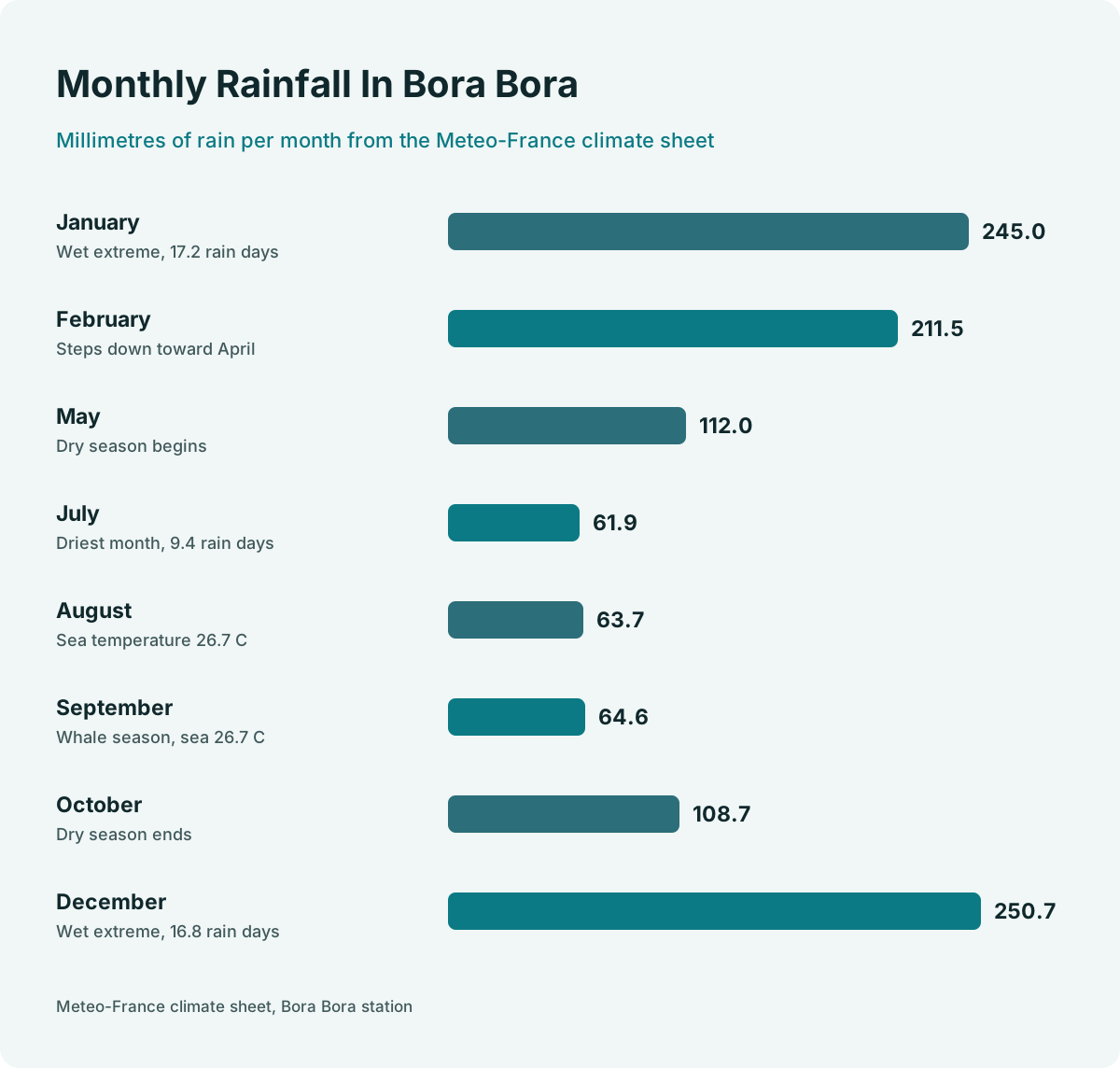
The best time of year to snorkel in Bora Bora is the dry season, May to October, when monthly rainfall drops to between 61.9 and 112 mm and rain days fall to between 8.8 and 11.4 per month, against 245 mm and 17.2 rain days in January. Operators and guides consistently describe this window as the calmest and clearest the lagoon gets.
The dry season wins on the numbers, and the numbers are not close. The Meteo-France climate sheet for the Bora Bora station records January at 245 mm of rain across 17.2 days with at least 1 mm, against 61.9 mm across 9.4 days in July. That is the difference between planning around squalls and planning around sunshine. A secondary sea-temperature series puts the lagoon at 26.7 C in August against 28.9 C in March, so the dry season is also the cooler-water half of the year, which most snorkelers find pleasant rather than cold for a three to four hour tour.
What the dry season gives you beyond the rainfall line is behavioral. Calmer mornings mean the shallow coral gardens on the lagoon's southern side are at their most mirror-like, and boats can hold position more comfortably at the ray and shark stops. Guides describe clearer water in the dry season, and while no official visibility record exists for the lagoon, the pattern tracks the rainfall: less runoff, less sediment, more light reaching the reef. For photographers and first-time snorkelers alike, that combination matters more than a degree or two of water temperature. Those same calm conditions play out a little differently in Moorea, so if you're comparing islands, the Moorea vs Bora Bora snorkeling comparison explains what each lagoon does best.
The counterargument is crowd and cost. July and August sit inside the dry season and are typically the busiest and most expensive months of the Bora Bora year, when resort rates peak and the most popular boats fill first. May, June, September and October deliver comparable rainfall figures with noticeably fewer people on the water. September and October in particular are a quiet sweet spot: still firmly dry-season statistics, but past the August rush.
If your dates are fixed by school holidays or a work calendar, the wet season is still very workable, and the section below breaks down exactly what changes. If your dates are flexible, aim for May, June, September or October and you get the dry season's water without the dry season's peak-season crowd.
What Is The Best Month To Visit Bora Bora?
September is arguably the single best month: rainfall sits at 64.6 mm across 9.3 rain days, the August crowds have left, humpback whale season is open, and the sea is still dry-season calm at 26.7 C. October runs it close at 108.7 mm, with the whale season still live through November.
Month-by-month, the climate record splits the year cleanly. Here is the full picture from the Meteo-France station data, with the secondary sea-temperature series alongside.
| Month | Rainfall (mm) | Rain days (1 mm or more) | Sea temperature (C) |
|---|---|---|---|
| January | 245.0 | 17.2 | 28.4 |
| February | 211.5 | 15.3 | 28.4 |
| March | 168.1 | 14.5 | 28.9 |
| April | 143.9 | 11.8 | 28.7 |
| May | 112.0 | 11.4 | 28.2 |
| June | 85.5 | 9.7 | 27.4 |
| July | 61.9 | 9.4 | 26.9 |
| August | 63.7 | 8.8 | 26.7 |
| September | 64.6 | 9.3 | 26.7 |
| October | 108.7 | 10.6 | 27.3 |
| November | 138.5 | 12.3 | 27.9 |
| December | 250.7 | 16.8 | 28.3 |
Read that table as three bands rather than twelve boxes. January and December are the wet extremes, at 245 and 250.7 mm. February through April step down steadily. May through October is the dry block, with June, July, August and September all under 90 mm. The rain-day column tells the subtler story: even the wettest month averages 17.2 rain days, which leaves roughly half the month dry, and wet-season rain in the tropics tends to arrive in short, heavy bursts rather than all-day gloom.
The best month also depends on what you want beside the snorkeling. Humpback whale season runs July to November, and while no tour in this lineup is a whale-watching product, an approved operator's boat may legally observe whales from 100 m under the rules set by Tahiti Tourisme and the environmental authorities. Cruise traffic, which competes for tour seats, concentrates in the drier season. And the peak resort months of July and August compress availability on the most reviewed boats, so a same-week booking in August is a gamble in a way a September booking is not.
Matching a month to a tour is where this stops being abstract. The featured full-day lagoon group tour with lunch is a 6 hour small-group circuit, from $173 per person, 5.0 from 1,715 reviews, the most reviewed listing in the lineup; in peak months it is the one to book well ahead. You can see its full-day lagoon tour details and check availability on the live listing. In shoulder months, same-week space is far more realistic across the whole fleet.
The trio above spans the timing question neatly: a full-day with lunch for a settled dry-season forecast, a 3.5 hour signature circuit for a morning you want free by early afternoon, and a 2.5 hour eco cruise for a day when the sky looks changeable and you want the shortest commitment to the weather.
Dry Season Or Wet Season: Which Suits Your Snorkel Tour?
Pick the dry season, May to October, for calm water, clearer lagoon conditions and the full range of tours at their most reliable. Pick the wet season, November to April, for warmer water at 28 C plus, fewer crowds and easier availability, accepting a higher chance of rain squalls and softer clarity on any given day.
The dry season is the answer for most visitors, but the wet season is not a write-off, and it helps to know precisely what you are trading. Here is the honest side-by-side.
| Factor | Dry season (May to Oct) | Wet season (Nov to Apr) |
|---|---|---|
| Monthly rainfall | 61.9 to 112 mm | 138.5 to 250.7 mm |
| Rain days per month | 8.8 to 11.4 | 11.8 to 17.2 |
| Sea temperature | 26.7 to 28.2 C | 27.9 to 28.9 C |
| Typical crowd level | Peak in Jul and Aug, moderate in shoulder | Low, with quiet boats |
| Booking lead time | Longer in Jul and Aug | Shorter, more same-week space |
| Character of rain | Light and brief if any | Heavier squalls, longer bursts |
Two practical notes soften the wet-season column. First, tours list free cancellation on almost every listing, and weather cancellations by the operator allow rebooking or a refund, so a wet-season booking is not money at risk. Second, the lagoon itself buffers weather: the reef that encloses it means a day that is rough on the ocean side can still be flat and snorkelable inside, which is one reason operators run year round.
The wet season also has a wildlife angle. Mantas are resident in the lagoon rather than seasonal, and the listing for the Anau manta cleaning station on the east side describes visits by boat tour, with guides deciding conditions on the day. Warmer wet-season water is comfortable for longer swims, and our page on manta ray timing and etiquette covers what to expect across the year.
For families weighing the wet season, the snorkeling with kids question interacts with timing: calmer dry-season water is easier for children, though the warmest water of March at 28.9 C is also appealing for short swims.
Whatever the month, the full-day format is the one most exposed to weather simply because it spends more hours on the water, and it is also the format most worth protecting with an early booking in the busy half of the year.
When Are Manta Rays In The Bora Bora Lagoon?
Manta rays are resident in the Bora Bora lagoon year round, so there is no closed season; what changes is conditions at the Anau cleaning station on the east side, which guides assess daily. Reef manta rays are the common species, with eagle rays and turtles also reported at the site. Sightings are never guaranteed, on any tour, in any month. Before booking around a manta swim, it helps to read our guide to how safe Bora Bora is for visitors and snorkelers right now, which covers wildlife rules, health, and which tours run safely in every season.
The Anau cleaning station is the lagoon's signature manta site, and the current guiding consensus is that it is accessible only by boat tour, with no recommended shore approach. That makes manta timing a question of operator and conditions more than calendar: the site's exposure means a calm dry-season morning widens the days a guide will run it, while a fresh east wind can close the option entirely regardless of month.
Etiquette at the site is codified rather than advisory. The rules require snorkelers to stay at the surface, remain calm and horizontal, and never dive down, touch, chase or block the animals, with mantas protected under French Polynesia's environmental code. A good guide briefs this before you enter the water; the dedicated manta guide walks through the full set of expectations.
The rest of the lagoon's cast is also non-seasonal in the main. Blacktip reef sharks, typically 0.5 to 1.5 m, are the common shark species on tours, present all year; stingrays gather at the shallow sand stops regardless of month. The one genuinely seasonal large animal is the humpback whale, July to November, but no listing in this lineup is a whale-watching product and no snorkel tour should be booked on a whale expectation.
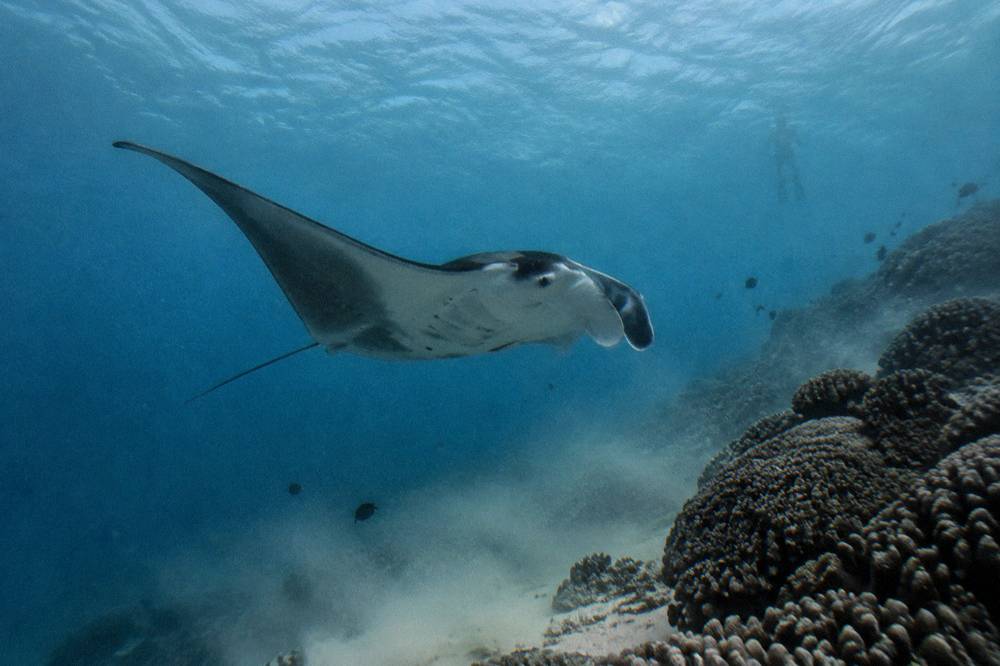
For a manta-focused trip, the practical timing advice is this: book the dry season for the highest number of workable Anau days, choose a small-group or private format so the guide has flexibility on site order, and treat any manta encounter as a possibility the listing and operators describe as commonly reported rather than a promise.
The Reef Discovery half day above is a natural fit here: a 3.5 hour small-group signature circuit, from $134 per person, 5.0 from 1,051 reviews, short enough to fit around the day's best weather window and flexible enough in format to adjust stops.
What About Crowds, Trade Winds And Cruise Traffic?
July and August are the busiest months, with peak resort occupancy and the most competition for seats on popular boats; cruise traffic also concentrates in the May to October dry season. The southeast trade winds blow most steadily in the winter half of the year, typically freshening afternoons, which favors morning departures.
Crowds in Bora Bora arrive on two schedules. Resort guests peak in July and August, the classic northern-summer holiday window, when the most reviewed boats fill first and prices across the island sit at their highest. Cruise passengers add a second layer, and port research shows cruise activity itself concentrates in the drier season for calmer lagoon conditions. Ships anchor in the lagoon and tender passengers to the Vaitape quay, a ride of typically 15 to 20 minutes, and calls commonly give passengers 9 to 12 hours ashore, enough for a full-day tour with margin or a relaxed half day.
That tender logistics reality is why tour pickups include the Vaitape quay alongside the resort docks: a cruise passenger can walk from the tender wharf to a meeting point in a couple of minutes. The trade-off for staying visitors is that on days with a ship in port, shared boats carry more demand. In shoulder months that pressure disappears almost entirely.
The trade winds are the quieter factor in the timing question. The southeast trades blow with most persistence across the dry-season months, and the reliable pattern, as guides describe it, is calm mornings and a freshening afternoon breeze. That breeze is rarely a problem inside the sheltered lagoon, but it can texture the surface at the more exposed stops and it can matter at Anau on the east side. The rule of thumb that follows: in any month, book the morning departure.
| Timing factor | Best months | What to expect |
|---|---|---|
| Fewest crowds on the water | May, Jun, Sep, Oct | Dry-season conditions, thinner boats |
| Warmest water | Feb to Apr | 28.4 to 28.9 C, but wetter months |
| Whale season (observer only) | Jul to Nov | Approved operators keep 100 m distance |
| Lowest rainfall | Jun to Sep | 61.9 to 85.5 mm per month |
| Most cruise calls | May to Oct | More shared-boat demand in port days |
| Quietest booking pressure | Nov to Apr | Easier same-week availability |
One genuine timing trap deserves a flag: the southern reef off Matira now carries a full-protection zone. A December 2025 decree established the Popora rahui, a 574 hectare no-take area closed to fishing, boating and nautical activity, French Polynesia's first integral lagoon reserve of this class, as reported in detail at the time. No tour in this lineup enters it, and none should be expected to; the coral gardens and ray stops the boats use sit elsewhere in the lagoon. If you read older trip reports describing southern-reef itineraries, treat them as history.
For readers weighing the clearest-water question month by month, our where is the clearest water piece goes deeper than season alone.
Morning Or Afternoon: What Time Of Day Is Best?
Morning is the better bet in every season: guides and operators consistently describe calmer surface conditions before the afternoon trade wind fills in, and the light is better on the reef. Afternoon departures still run and still sell, but on a windy day the morning boat gets the smoother water at the same price.
The half-day fleet makes this choice explicit. The shared morning or afternoon snorkel from H2O Bora Bora, 3.5 hours from $130 per person, 5.0 from 774 reviews, sells both departure windows at the same fare, so the morning slot is effectively a free upgrade in water quality. The eco snorkel cruise with Moana Adventure Tours, 2.5 hours from $112, 4.8 from 604 reviews, offers the same kind of split-day choice. On a booking page the two options look identical; on the water they rarely are.
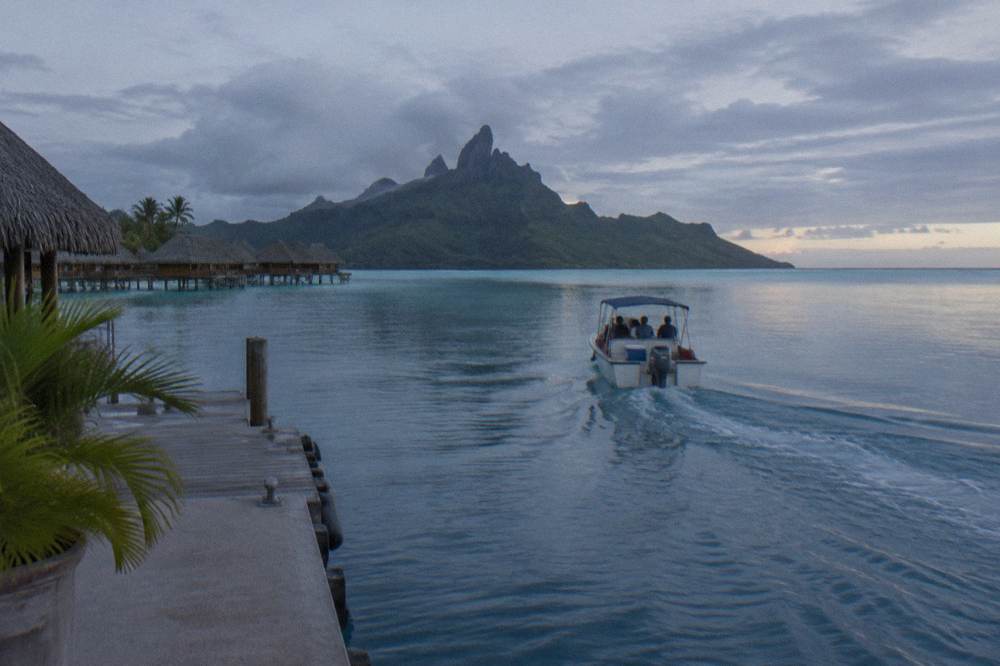
The exception is the wet season squall. From November to April, rain arrives in bursts that can land in the morning as easily as the afternoon, so the usual calm-morning pattern is less reliable and the day's first departure is not automatically the best. The practical wet-season move is to book with free cancellation, watch the forecast the day before, and swap departure if the sky dictates. Nearly every listing carries free cancellation, which makes this a low-friction strategy.
Light matters too, beyond comfort. Low morning sun over a shallow coral garden lights the reef flat and makes fish behavior easier to watch; by mid-afternoon the angled light and textured surface flatten the scene. Photographers chasing the postcard water should treat the first departure as the whole point of the booking.
The eco cruise above is a good afternoon fallback as well: at 2.5 hours it is the shortest shark and ray commitment in the lineup, so even a less-than-perfect afternoon window leaves time to spare.
What Does The Season Mean For Which Tour You Book?
Longer, exposed formats reward the dry season: the full-day tours and the Anau-inclusive circuits are at their best from May to October. Short formats, private boats and the flexible-departure half days suit the wet season, where a 2.5 to 4 hour commitment can be slotted into the day's best weather window instead of betting six hours on it.
Map the lineup's three natural formats against the season and a pattern appears. The full-day lagoon and motu lunch tours, six to seven hours including a beach meal, are the most weather-exposed and the most crowd-sensitive, so they benefit doubly from shoulder-month booking: calmer water and available seats. The half-day lagoon snorkels at 2.5 to 5 hours are the all-season workhorses. The private boats, from $560 to $650 per group for a 3.5 hour trip, buy schedule control, which in the wet season is worth more than the per-person saving of a shared boat.
| Tour format | Best season fit | Why |
|---|---|---|
| Full day with motu lunch (6 to 7 hrs) | Dry season shoulder months | Longest exposure to weather; fills in Jul and Aug |
| Half-day shared snorkel (2.5 to 5 hrs) | Any month, morning slot | Short commitment, biggest lineup segment |
| Private boat (from $560 per group) | Wet season flexibility | You pick the window, not the schedule |
| Catamaran with floating bar | Calm dry-season afternoons | Sailing comfort is wind-dependent |
| Jet ski and snorkel combo | Dry season | Combines two weather-dependent activities |
The 4WD and jet ski combos deserve a note, because they stack two activities into one long day, from 6 to 8 hours, from $158 to $432 per person depending on the operator. Stacking doubles your weather exposure, which again argues for the dry season if the combo is the plan. The catamaran sailing trip with the floating bar, from $309 per person, 4.9 from 164 reviews, is the one format that actually wants some wind, though it still prefers the dry season's warmer, drier afternoons over a wet-season squall.
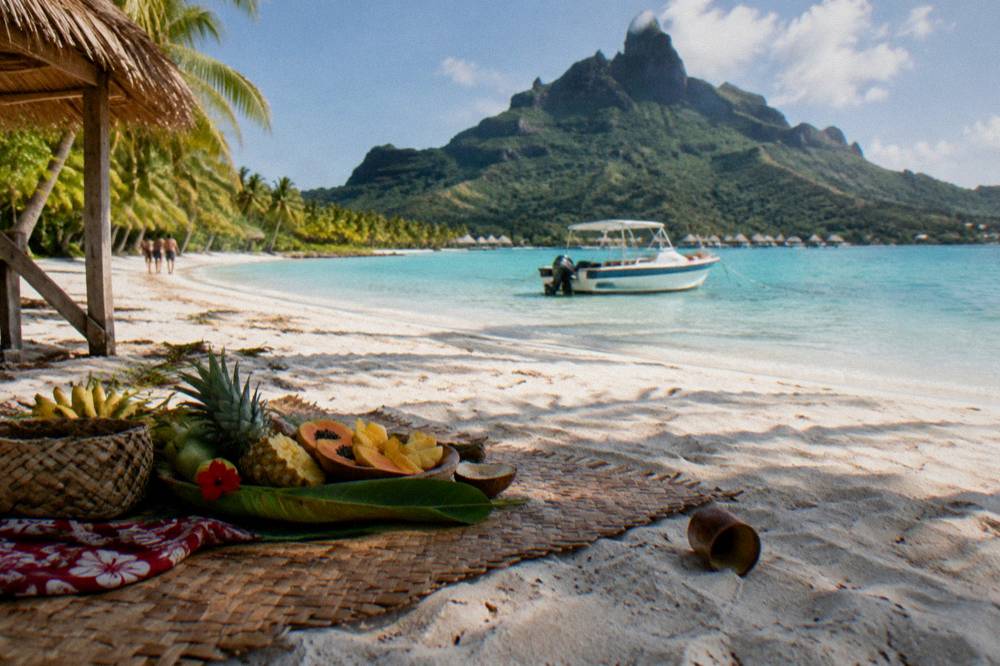
It is also worth saying plainly what this site is: Bora Bora Snorkeling Tours exists to compare exactly these listings, and the private versus group comparison and the what to bring guide finish the planning picture that timing starts.
Should You Book Ahead Or Wait For The Forecast?
Book ahead for July, August and any full-day tour in the dry season, because the popular boats fill and the prices do not drop. For wet-season trips and short half-day formats, booking a few days out with a free-cancellation listing lets you read the forecast first, since almost every listing allows cancellation without penalty.
The booking clock and the season clock run together. In the peak months, the most reviewed listings, the full-day lagoon group tour with its 1,715 reviews and the Reef Discovery half day with 1,051, are the ones that sell out first, and a wait-and-see strategy in August mostly sees seats gone. In November through April, the same listings typically have space close to the date, and the forecast-driven swap becomes realistic.
Free cancellation is the mechanism that makes late booking rational, and it is listed on nearly every tour in the lineup, from the $105 half-day Bora Bora Experience with fruits on Motu Fanfan, the cheapest listing on the site, up to the $1,776 per group private full day with a water lunch. Operator-initiated weather cancellations allow rebooking or a full refund, so the downside of a wet-season gamble is small. Tourists planning a full trip budget can also factor in the local visitor tax, currently 200 XPF per person per night at classified hotels and cruise ships, with rates changing in 2027 when communes gain new ceilings.
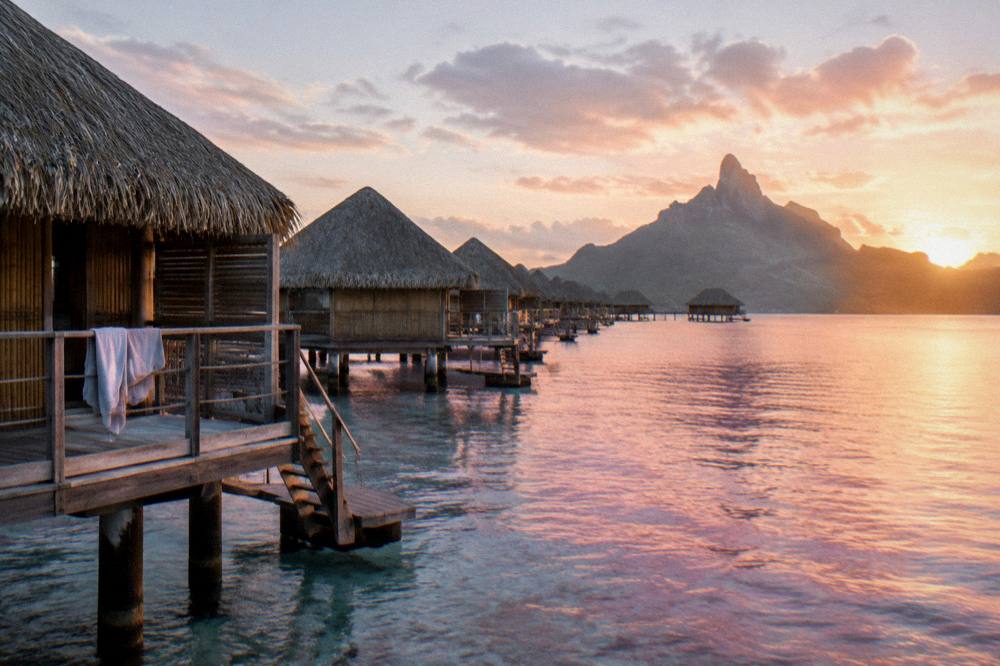
A reasonable summary of everything above: choose May, June, September or October if you can, book the morning departure whichever month you choose, book early if your month is July or August or your tour is six hours long, and use free cancellation as your forecast hedge in the wet half of the year. The lagoon is swimmable in all twelve months; the difference between a good decision and a great one is mostly a calendar and a departure time.
Common Questions About The Best Time To Snorkel In Bora Bora
What is the best month to visit Bora Bora?
September is the strongest single month: 64.6 mm of rain across 9.3 rain days, past the August crowd peak, still inside humpback whale season and firmly in the dry-season weather pattern. October runs it close at 108.7 mm with the whale season still open through November.
Can you snorkel in Bora Bora in the wet season?
Yes. Every tour in the lineup runs year round, sea temperature sits at 27.9 to 28.9 C from November to April, and rain typically arrives in short bursts rather than all day. Book short formats and use free cancellation to swap around the forecast.
Is the water cold in the dry season?
No. A secondary sea-temperature series puts the lagoon at its coolest in August at 26.7 C, warm by most snorkeling standards. The warmest water, 28.9 C in March, falls in the wet season.
When can you see whales in Bora Bora?
Humpback whale season runs July to November. No tour in this lineup is a whale-watching product; approved providers observe from 100 m under Tahiti Tourisme's rules, and a snorkel tour should never be booked on a whale expectation.
Are mantas only seen at certain times of year?
Mantas are resident in the lagoon year round. Anau cleaning station access depends on daily conditions and guide judgment, not the calendar, and sightings are never guaranteed on any tour in any month.
Do I need to book a snorkel tour in advance?
In July and August, yes, especially for full-day tours and the most reviewed listings. In the wet season and for short half-day formats, booking a few days ahead on a free-cancellation listing is usually enough.